
Civil War 2026
Some say the world is on fire. Others urge restraint. The question is not who is right. The question is what we have forgotten.

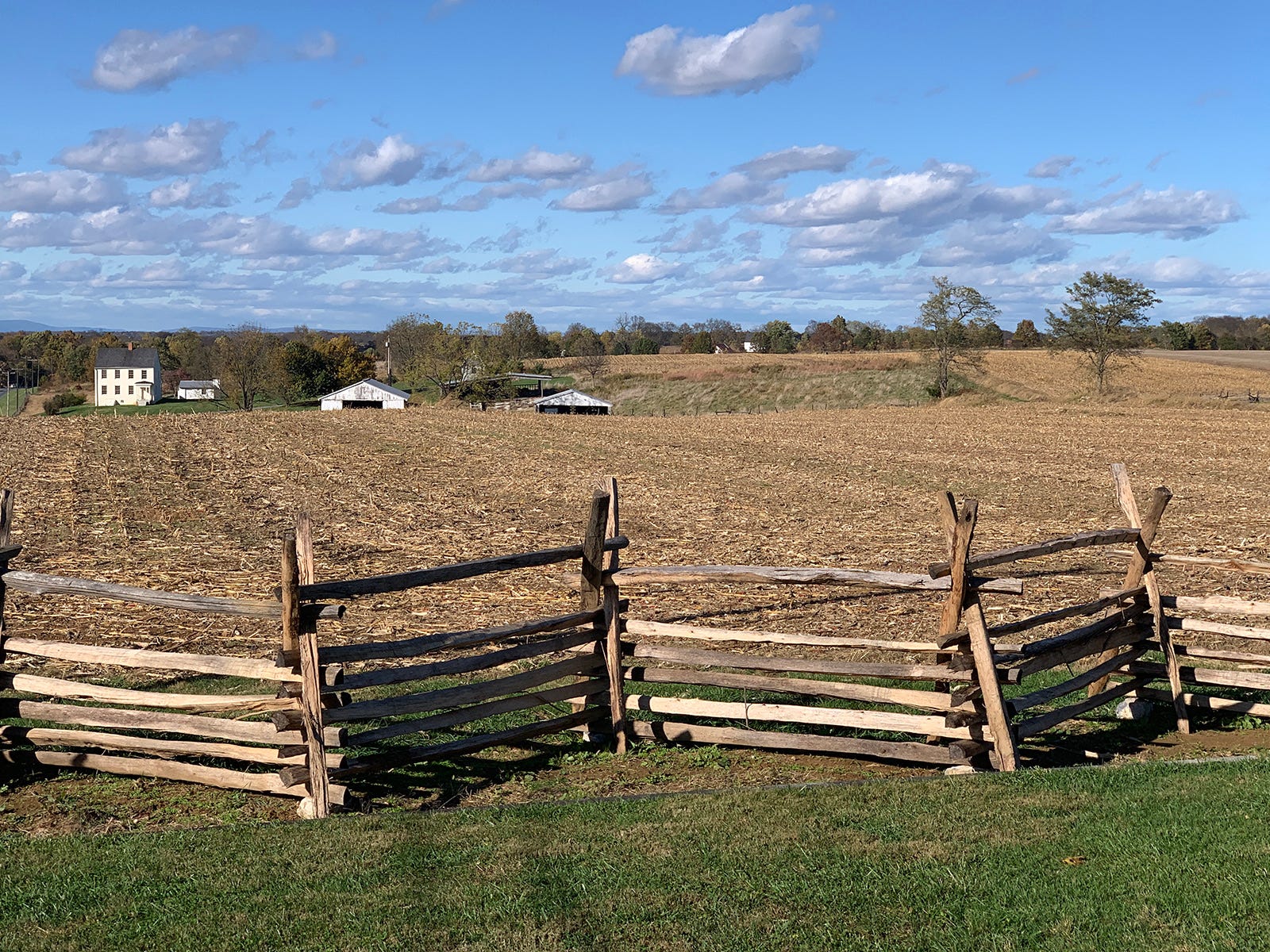
Image: Miller’s Cornfield looking north into the Cornfield with the Miller Farm in the distance. NPS Antietam/ B.Baracz. https://www.nps.gov/media/photo/gallery-item.htm?id=e21c1271-9750-4fd4-8100-9f9fe3759264&gid=4FBB62F5-9AF4-4482-A924-861EFB9D0902
Begin with a field.
Corn cut low along a narrow Maryland creek. Fence rails splintered and leaning. A small white church set back from the road. By midmorning the smoke lay so thick that men fired into gray shapes and prayed they were not shooting their own. By afternoon the stalks were trampled flat. By evening the ground was black where blood had dried.
A staff officer tried to cross the field at dusk and found he had to step carefully—boots slipping, bodies swollen, faces turned to the sky. Some were so covered in dust and torn earth that he had to look twice to recognize them as human.
If you say you want a civil war, begin there. Begin with the weight of a body when four men lift it onto a wagon. Begin with the letter home that says, simply, “He died bravely,” and nothing about the way his arm was taken off at the shoulder.
Now step away from the creek.
A cottage on a hill in Washington. Late afternoon light through tall windows. A desk worn smooth at the edges. Outside, the city hums. Inside, the air is still.
On the wall hangs a copy of the Declaration of Independence. The parchment’s script loops across the page, steady and elegant:
All men are created equal.
Elsewhere, long before that sentence was ever framed on museum walls, it was read aloud in rooms that smelled of kerosene and damp wool.
In Philadelphia, in the 1830s, Black delegates gathered for a convention. Coats brushed with winter dust. Boots left by the door. On the table: ink, quills, sheets of paper weighted down by a Bible. One man stands and reads from the Declaration. The room is quiet.
He does not ask whether the sentence is true.
He asks why it stops at the color line.
Outside, white men walk past without glancing in.
In Rochester, on a hot July day, a crowd gathers beneath bunting and flags. A speaker rises and praises liberty. Then another rises—tall, composed—and asks the audience to look at their own document. He does not tear it up. He reads it, line by line. The words hang in the air, heavy.
All men are created equal.
Then he asks what that means for the man in chains.
There is no applause at first.
The Declaration has been turned from ornament to mirror.
In churches across the South, enslaved men and women whisper those same words after dark. In cabins lit by embers, they repeat phrases they have heard recited in town squares—liberty, equality, rights. The words travel farther than the men who wrote them ever intended.
After the war, ballots are cast in courthouses that still smell of smoke. Black men in stiff collars wait in line, hats in hand. Some sign with an X. Some write their names slowly, carefully, pressing hard into the paper. Inside the statehouse, new constitutions are debated. Public schools are proposed. Roads planned. Amendments ratified.
Then, a few years later, a different line forms—this one outside a registrar’s office. A clerk slides a sheet across the counter.
“Read this,” he says.
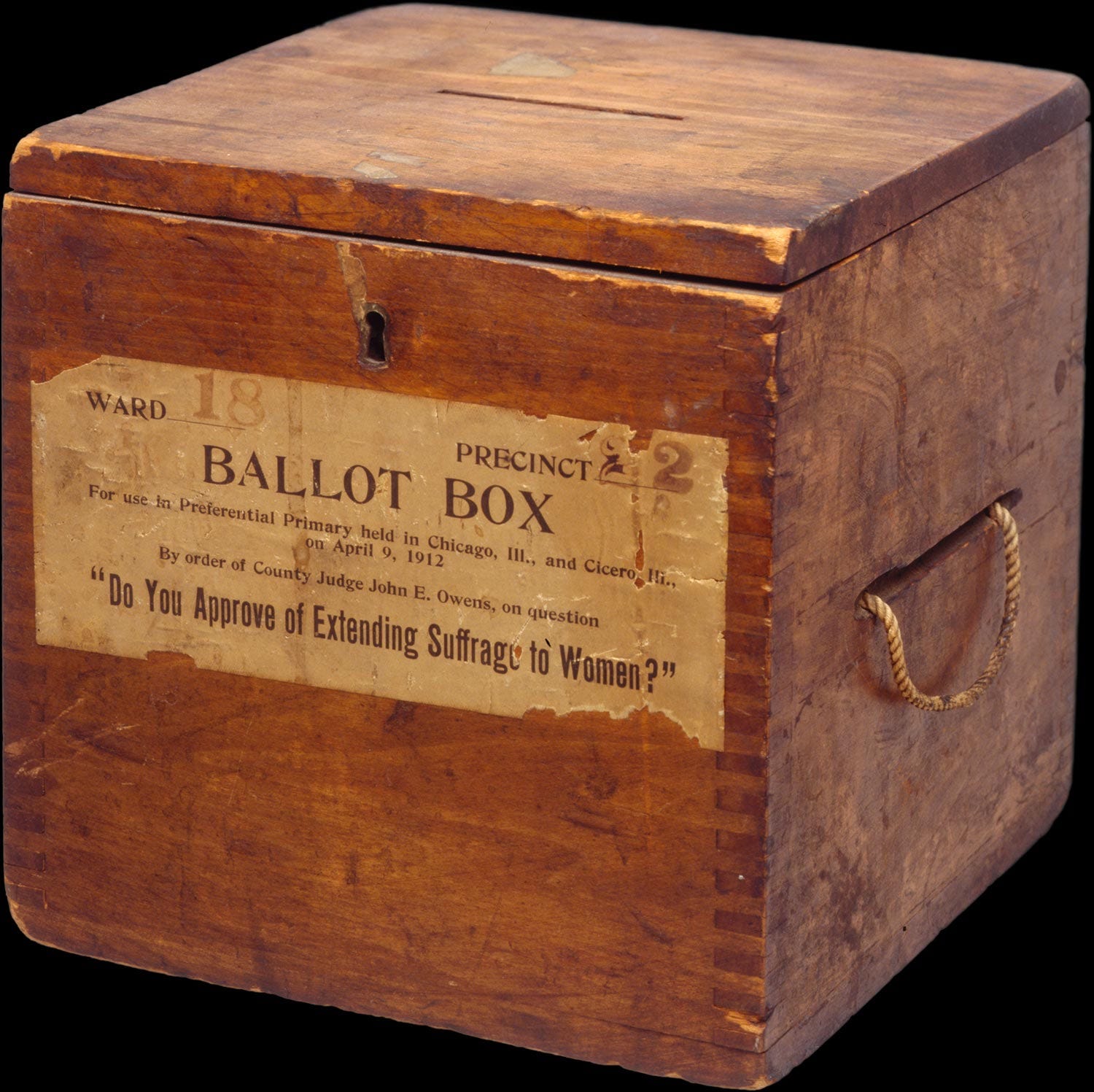
Image: 1912 Chicago ballot box. Source: Clio https://votesforwomen.cliohistory.org/19objects/1912-ballot-box-chicago
The paragraph is dense. The clock ticks. A man who had voted before lowers his eyes and begins to sound out the words. Outside, two white men lean against a post, rifles resting across their knees.
Later that night, hooves on dirt. A knock at a door. A hooded figure in the yard. The ballot box and the burning cross share the same county.
November air on a Pennsylvania hillside. Fresh earth laid in long rows. A crowd stands with hats removed. A tall man in a black coat speaks briefly—so briefly that some think the ceremony unfinished. He does not linger over strategy or clauses. He speaks of a proposition.
Conceived in liberty.
Dedicated to the idea that all men are created equal.
The wind moves across the graves.
He calls it unfinished work.
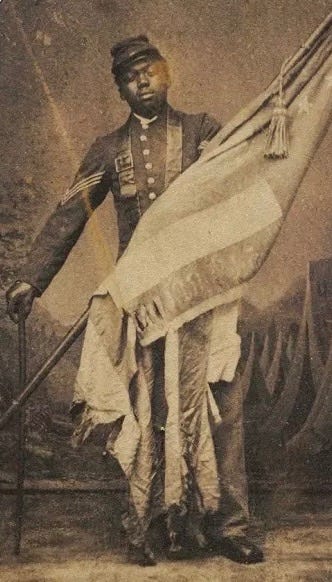
Image:Sgt William Carney holding the American Flag, ca. 1894. Photograph by John Ritchie, Carte-de-vista album of the 54th Massachusetts Infantry Regiment, 1864, album, National Museum of African American History and Culture. NPS https://www.nps.gov/articles/william-h-carney.htm
In 1894, a man stands in Washington and speaks of jail doors broken open. Of bodies taken from cells. Of fire after death. His voice is steady. Members shift in their seats. He repeats the language of the founding—civilization, equality, rights—and asks how it stands beside what he has described. The chamber is quiet.
On a bridge in Alabama, nearly a century later, men and women kneel as troopers advance. Tear gas blooms white against the sky. Clubs rise and fall. A woman’s coat is torn at the shoulder. Someone drops a small American flag; it lies in the road, its fabric streaked with mud.
Behind them, in a church basement, someone has taped a poster to the wall:
All men are created equal.
The ink is smudged where a thumb pressed too hard.
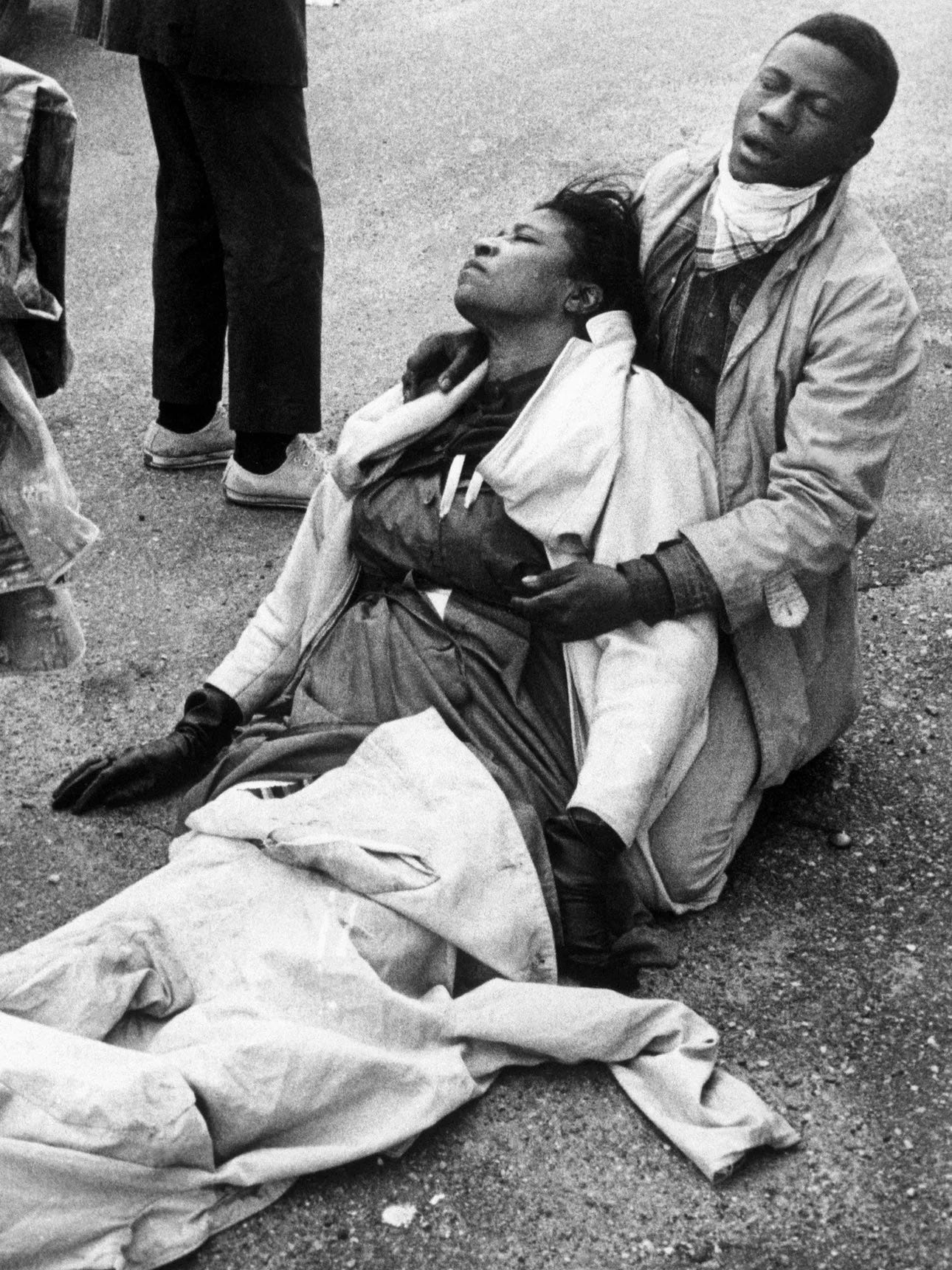
Image: Joe Jones, a civil rights marcher suffering from exposure to tear gas holds an unconscious Amelia Boynton Robinson after mounted police officers attacked marchers on March 7, 1965, in Selma, Ala., as they were beginning a 50-mile march to Montgomery to protest race discrimination in voter registration. https://snccdigital.org/people/amelia-boynton/
Elsewhere, in quiet offices, lines are drawn on maps. Districts carved into shapes that bend around neighborhoods. A signature here. A rule change there. The room is carpeted. The lights hum overhead. No smoke. No shouting. The pen moves steadily across the page.
On a television screen, a law is described as procedural. Technical. Necessary.
Outside, a polling place closes at five instead of seven.
In a gun show hall lit by fluorescent tubes, men lean over folding tables stacked with rifles. A mother in jeans stands at the end of an aisle, listening. She runs her hand along the stock of a weapon.
“Just in case,” she says softly, almost apologetically.
In a church not far away, worshippers bow their heads. As the offering plate passes, metal glints beneath jackets. The pastor speaks of siege, of enemies at the gate. The congregation murmurs assent.
In a small apartment, an elderly woman smooths out a yellowed newspaper clipping. It shows her father, hat in hand, on the courthouse steps in 1868. She traces the date with her finger.
He had believed the ballot would hold.
Back at the Maryland field, the corn grows again. The fences have been rebuilt. Visitors walk in silence, reading placards. Some pause at the photographs—rows of bodies, stiff and dark, laid out beside the church. A child tugs at her mother’s sleeve.
“Is this what a civil war looks like?”
Her mother does not answer immediately.
The Declaration still hangs on walls. Its ink has not faded. The sentence remains.
All men are created equal.
In basements and bridges, in courthouses and classrooms, in cabins and convention halls, it has been read aloud by those it did not protect.
It does not enforce itself.
It waits—for someone to stand, to speak it, and to insist that the distance between those words and the world outside the window be narrowed, not widened.
The field at Antietam is quiet now.
The question is not.
Intellectual Map
Foundational Texts of Black Political Thought
Douglass, Frederick. Narrative of the Life of Frederick Douglass, an American Slave. Boston: Anti-Slavery Office, 1845.
———. “What to the Slave Is the Fourth of July?” Speech, Rochester, NY, July 5, 1852.
Du Bois, W. E. B. The Souls of Black Folk. Chicago: A.C. McClurg, 1903.
Walker, David. “Appeal to the Coloured Citizens of the World.” Boston, 1829.
Reconstruction as Constitutional Fulfillment
Du Bois, W. E. B. Black Reconstruction in America, 1860–1880. New York: Harcourt, Brace and Company, 1935.
Foner, Eric. The Second Founding: How the Civil War and Reconstruction Remade the Constitution. New York: W. W. Norton, 2019.
———. Reconstruction: America’s Unfinished Revolution, 1863–1877. New York: Harper & Row, 1988.
Lynch, John R. The Facts of Reconstruction. New York: Neale Publishing, 1913.
———. A Short History of Reconstruction. Indianapolis: The Bobbs-Merrill Company, 1907.
Simpson, Brooks D. Advice After Appomattox: Letters to Andrew Johnson, 1865-1866. Knoxville: University of Tennessee Press, 19878
Franklin, John Hope. Reconstruction after the Civil War. Chicago: University of Chicago Press, 1961.
The Late Civil Rights Movement
Branch, Taylor. Parting the Waters: America in the King Years, 1954–1963. New York: Simon & Schuster, 1988.
King, Martin Luther Jr. “I Have a Dream.” Speech, Washington, DC, August 28, 1963.
Klarman, Michael J. From Jim Crow to Civil Rights: The Supreme Court and the Struggle for Racial Equality. New York: Oxford University Press, 2006.
National Association for the Advancement of Colored People (NAACP). Litigation archives. https://naacp.org
Black Women and Constitutional Democracy
Blain, Keisha N. Set the World on Fire: Black Nationalist Women and the Global Struggle for Freedom. Philadelphia: University of Pennsylvania Press, 2019.
Wells, Ida B. “Southern Horrors: Lynch Law in All Its Phases.” New York, 1892.
White, Deborah Gray. Ar’n’t I a Woman?: Female Slaves in the Plantation South. New York: W. W. Norton, 1999.
The Black Freedom Struggle as Democratic Theory
Gates, Henry Louis Jr. Stony the Road: Reconstruction, White Supremacy, and the Rise of Jim Crow. New York: Penguin Press, 2019.
Glaude, Eddie S. Jr. Democracy in Black: How Race Still Enslaves the American Soul. New York: Crown, 2017.
Wood, Gordon S. The Radicalism of the American Revolution. New York: Alfred A. Knopf, 1991.
Archival and Digital Resources
National Museum of African American History and Culture. Smithsonian Institution. https://nmaahc.si.edu
.The Frederick Douglass Papers. Library of Congress. https://www.loc.gov/collections/frederick-douglass-papers.
Civil Rights Digital Library. University of Georgia. https://crdl.usg.edu
.NAACP Legal Defense and Educational Fund. Archives and litigation resources. https://www.naacpldf.org
.