
Honor Was Their Weapon: The Origin of White Southern Violence
Some societies treat violence as failure. Others treat it as instruction. The antebellum South was not confused about the difference.

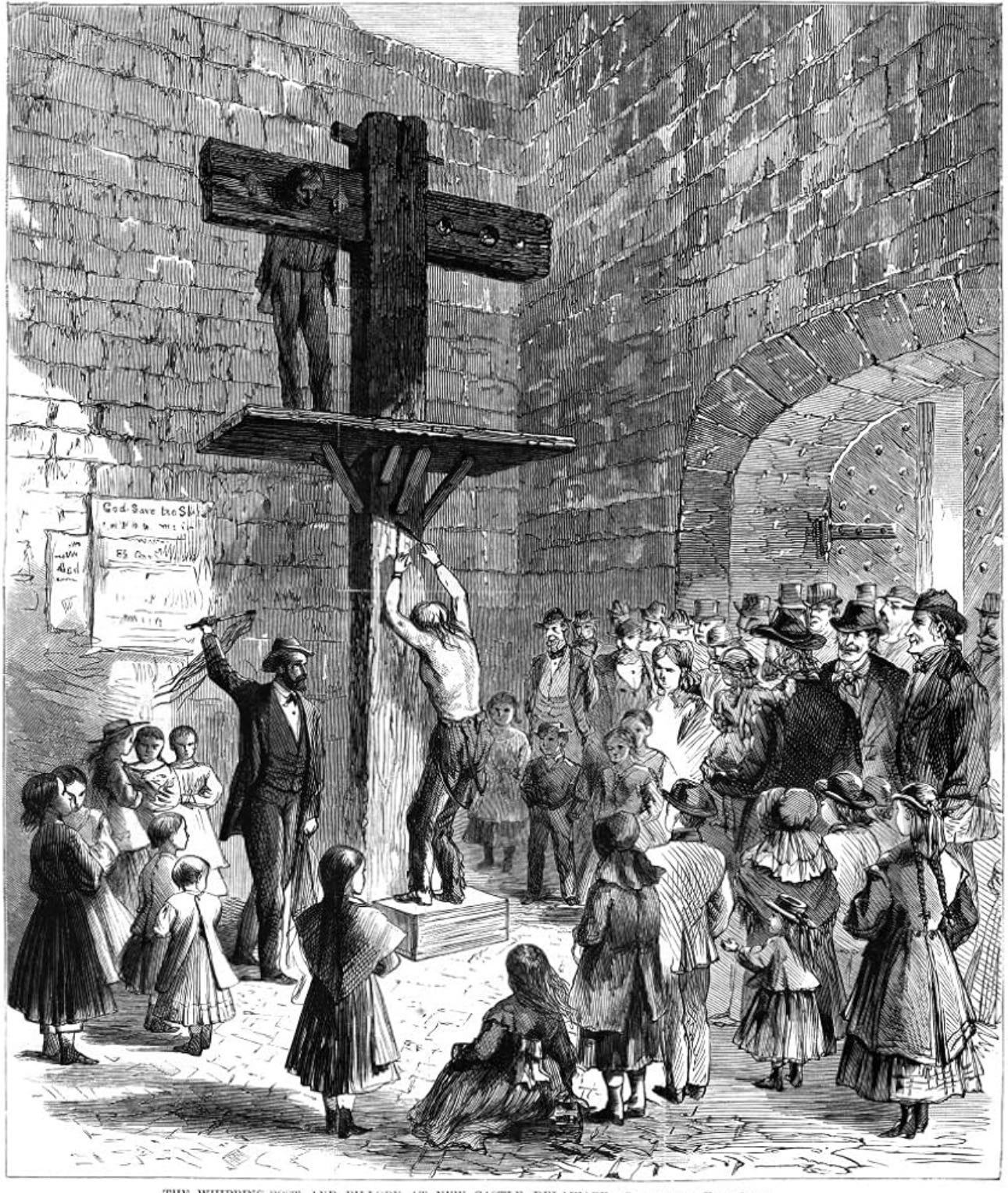
Image: Public Whipping, 1868. The public whipping post and pillory at New Castle, Delaware, 1868, one of the last states to continue the practice of public punishment. Contemporary American wood engraving after a drawing by Earl Shinn. Granger Collection.
At dawn the insult still hung in the air.
It had been spoken the night before, casually, almost lazily, across a dinner table heavy with silver and wine. A remark about lineage. About character. Nothing that would survive transcription. Everything that would survive memory. By morning it had hardened into fact. Notes were written. Seconds dispatched. Distances measured. Pistols cleaned. What mattered was not rage but recognition: the public acknowledgment that a man’s standing had been questioned and that the question could not be allowed to linger unanswered.
This was not lawlessness. It was order.
Long before the antebellum crisis, Southern society learned to resolve uncertainty through performance—through visible acts that clarified who commanded deference and who did not. The duel was one such act. Imported from Europe, it did not survive in the South as antiquarian ritual. It adapted. In a society where fortunes were unstable, genealogies contested, and democratic language threatened to level distinctions, the duel became a technology for drawing lines. To stand was to belong. To refuse was to vanish socially. Death was incidental. Reputation was the prize.
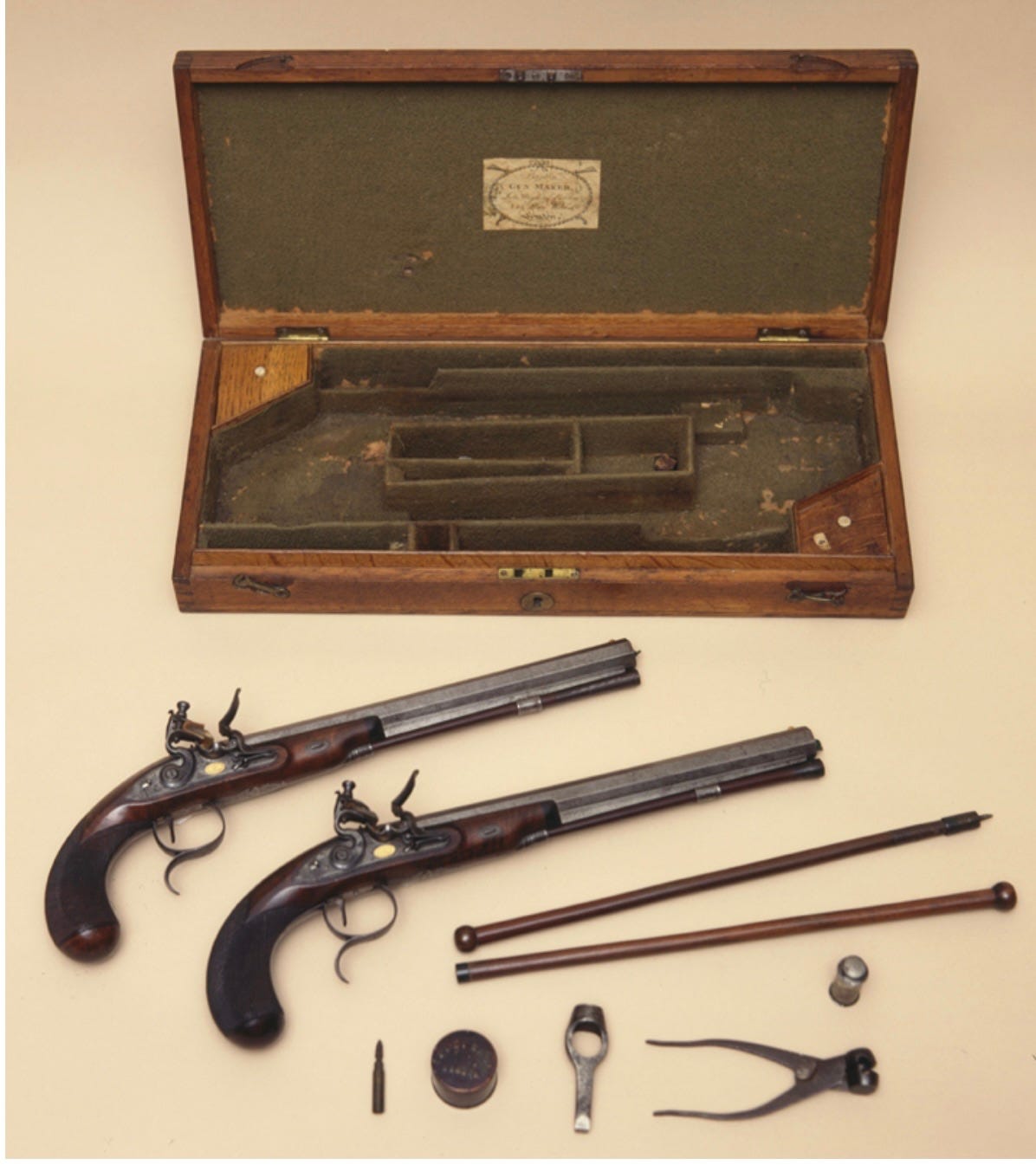
Image: Matched pair of dueling pistols, originally owned by John Randolph (1773-1833). Purchased in London and given to Randolph by Joseph Bryan (1773-1812), this set of pistols was manufactured by Wogdon and Barton. According to a brief article in the Virginia Historical Society Occasional Bulletin (Number 5 [October 1962], p. 8-11), Randolph carried these pistols to his duel with Henry Clay, but other weapons were used. (VMHC 1961.35.A-K).
What the duel taught—quietly, repeatedly—was that concession could be fatal and that dignity required risk. Politics would later absorb this lesson.
Move inland, away from the formalities of tidewater dining rooms, and violence shed its ceremony but not its purpose. In the upland South, where land was scarce, institutions thin, and authority distant, disputes did not rise to carefully staged encounters. They spread. A slight to one man became an obligation to his kin. Retaliation became inheritance. Feuds lasted not because they were irrational, but because they answered a practical question: who protects you when courts are slow or absent? The answer was blood. Family. The memory of prior injuries, carefully tallied.
Here, the state was not absent so much as optional. Law was something one used when it aligned with honor and ignored when it did not. Autonomy mattered more than legality. Suspicion of distant authority merged with a fierce defense of local standing. Law became a resource to be used when convenient and ignored when obstructive. What mattered was the capacity to act without permission.
And because economic autonomy was elusive, another form of standing took its place. Race.
A white man without land might possess little else, but he possessed status. That status had to be defended. Violence did the defending.
On plantations, violence assumed its most disciplined form. At night, men rode—not in secret, not illegally, but as appointed agents of the county. They carried lanterns and whips. They stopped enslaved people on the road, searched cabins, broke gatherings, delivered punishment on suspicion alone. This was not spectacle; it was routine. Names were recorded. Fines assessed for those who failed to serve. Patrol duty was civic obligation, folded into the rhythms of ordinary life.
What this taught was more consequential than fear. It taught participation. A man did not merely assent to the racial order; he enacted it. Night after night, the habits of command settled into muscle memory. Authority became something one did, not something one debated. Over time, terror lost its drama. It became background noise—the sound of order functioning as intended.
Honor stitched these worlds together. It traveled downward, from planters to smallholders to men with nothing but their name and skin color. It offered a shared language in a deeply unequal society. You might lack land. You might lack security. But you could possess honor. You could show it. Defend it. Enforce it. Honor demanded visibility, decisiveness, and, when challenged, force. Courts were slow. Violence was immediate. A man who relied too fully on abstract law risked appearing weak. Weakness invited challenge. Challenge demanded response.
Racial hierarchy gave this ethic its permanence. To be white was to be presumed honorable; to be Black was to exist outside the moral community entirely. Violence across the color line was not experienced as cruelty but as maintenance—of boundaries, of order, of truth itself. Punishment became pedagogy. Every blow taught a lesson about the world as it was meant to be.
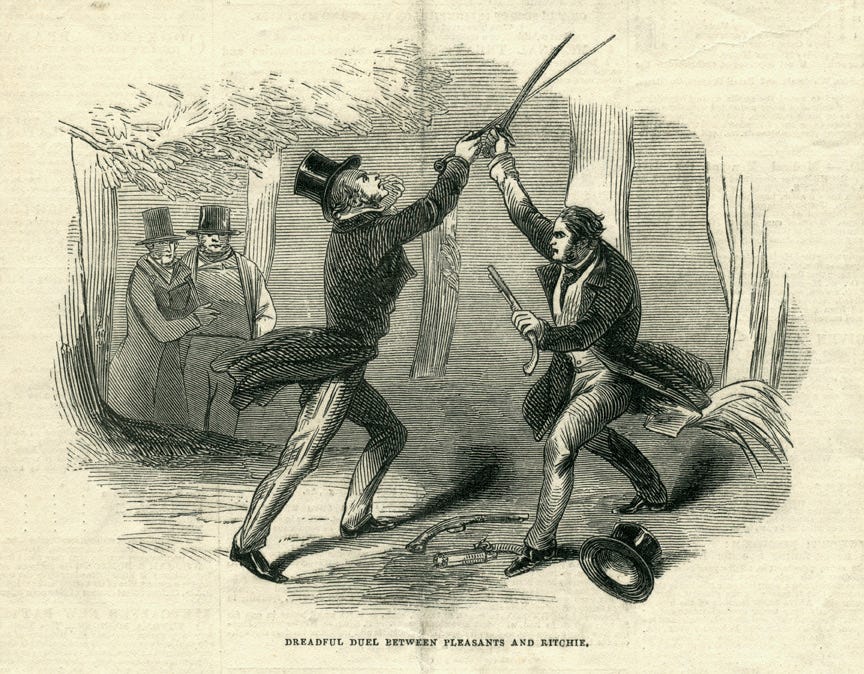
Image: Newspaper illustration about a duel between John Hampder Pleasants and Thomas Ritchie, Jr. (Virginia Museum of History and Culture.
And then the world began to argue back.
The language of rights crossed oceans. Sermons questioned bondage. Pamphlets circulated. Slavery, once managed quietly, now demanded explanation. Silence no longer sufficed. The South responded not by loosening its grip but by tightening it—constructing an intellectual scaffolding strong enough to hold domination without calling it domination. Slavery was declared benevolent. Hierarchy natural. Authority moral. Dissent dangerous.
This was the moment when older forms of violence aligned. The duel’s logic—insult requires risk—merged with the mob’s logic—community may act directly. Vigilante committees formed to silence speakers, burn presses, expel those who asked the wrong questions. Crowds rehearsed sovereignty. They learned that power did not always flow downward from constitutions. Sometimes it surged sideways, through numbers and shared outrage.
Even among whites, the screws tightened. Those who drifted, who failed to labor properly, who unsettled the visual order of mastery were disciplined—arrested, whipped, jailed, expelled. Freedom, it turned out, had conditions. Violence enforced them.
By the 1850s, the South had been practicing for generations.
Elites had learned that yielding invited humiliation. Ordinary whites had learned that belonging required enforcement. Communities had learned that law could be bypassed when it interfered with hierarchy. Violence had been normalized not as emergency but as method—ritualized in honor, routinized in patrols, sanctified in ideology.
So when compromise finally failed, when criticism felt like insult and restriction like annihilation, the leap to armed rupture did not feel like madness. It felt familiar. Secession was not merely a constitutional claim. It was an escalation of habits already mastered.
The war that followed did not introduce violence into Southern life. It revealed what had long been there: a social order that had trained itself, patiently and thoroughly, to believe that force was not the enemy of civilization—but its proof.
Intellectual Map
This bibliography coheres as a structural history of violence, hierarchy, and power, not a culturalist or psychological one. Franklin, Hadden, Morgan, Davis, and Genovese anchor violence as institutional necessity, while Merritt and Wyatt-Brown expose how class and honor disciplined white behavior across strata. Woodard functions best here as a macro-regional synthesis rather than an explanatory engine—useful for scaffolding, not causation.
Davis, David Brion. The Problem of Slavery in the Age of Revolution, 1770–1823. Ithaca, NY: Cornell University Press, 1975.
Fischer, David Hackett. Albion’s Seed: Four British Folkways in America. New York: Oxford University Press, 1989.
Franklin, John Hope. The Militant South, 1800–1861. Cambridge, MA: Harvard University Press, 1956.
Genovese, Eugene D. Roll, Jordan, Roll: The World the Slaves Made. New York: Pantheon Books, 1974.
Hadden, Sally E. Slave Patrols: Law and Violence in Virginia and the Carolinas. Cambridge, MA: Harvard University Press, 2001.
Merritt, Keri Leigh. Masterless Men: Poor Whites and Slavery in the Antebellum South. Cambridge: Cambridge University Press, 2017.
Morgan, Edmund S. American Slavery, American Freedom: The Ordeal of Colonial Virginia. New York: W. W. Norton & Company, 1975.
Woodard, Colin. American Nations: A History of the Eleven Rival Regional Cultures of North America. New York: Viking, 2011.
Wyatt-Brown, Bertram. Honor and Violence in the Old South. New York: Oxford University Press, 1986.
Thanks for reading 400 Years! Subscribe for free to receive new posts and support my work.
I think all of that, especially the level of cruelty, was imported from Europe with its endless wars and religious inquisitions. A lot of historians like to separate what happened here from what happened there in some futile attempt to preserve European dignity, but they are the fathers of cruelty.
This is so good! Thank you for your scholarship and insight. You have a much more accurate take on Southern Whites than Northern Whites do. Unless we grapple with the peer pressure aspect of white supremacy, we will never break its back. It is not as many presume a mere character flaw in individuals, it is an enforced way of life. For those who fear expulsion from the in-group, it is a powerful force for iniquity. I think Trump glommed onto this culture and manipulated it to his advantage. When you don't define yourself for yourself and allow your identity to be whatever your peer group says it is, you risk someone like Trump manipulating you.
When someone comes at me with their definition of "my" identity claiming I must conform to it, I know I am fixing to be manipulated and/or coerced. That kind of thing has to be slapped down immediately or it will metastasize. White people will do this to each other all the time. It is a fact, especially in the South.