
Why Africa is a Country
Many Worlds. One Grammar.

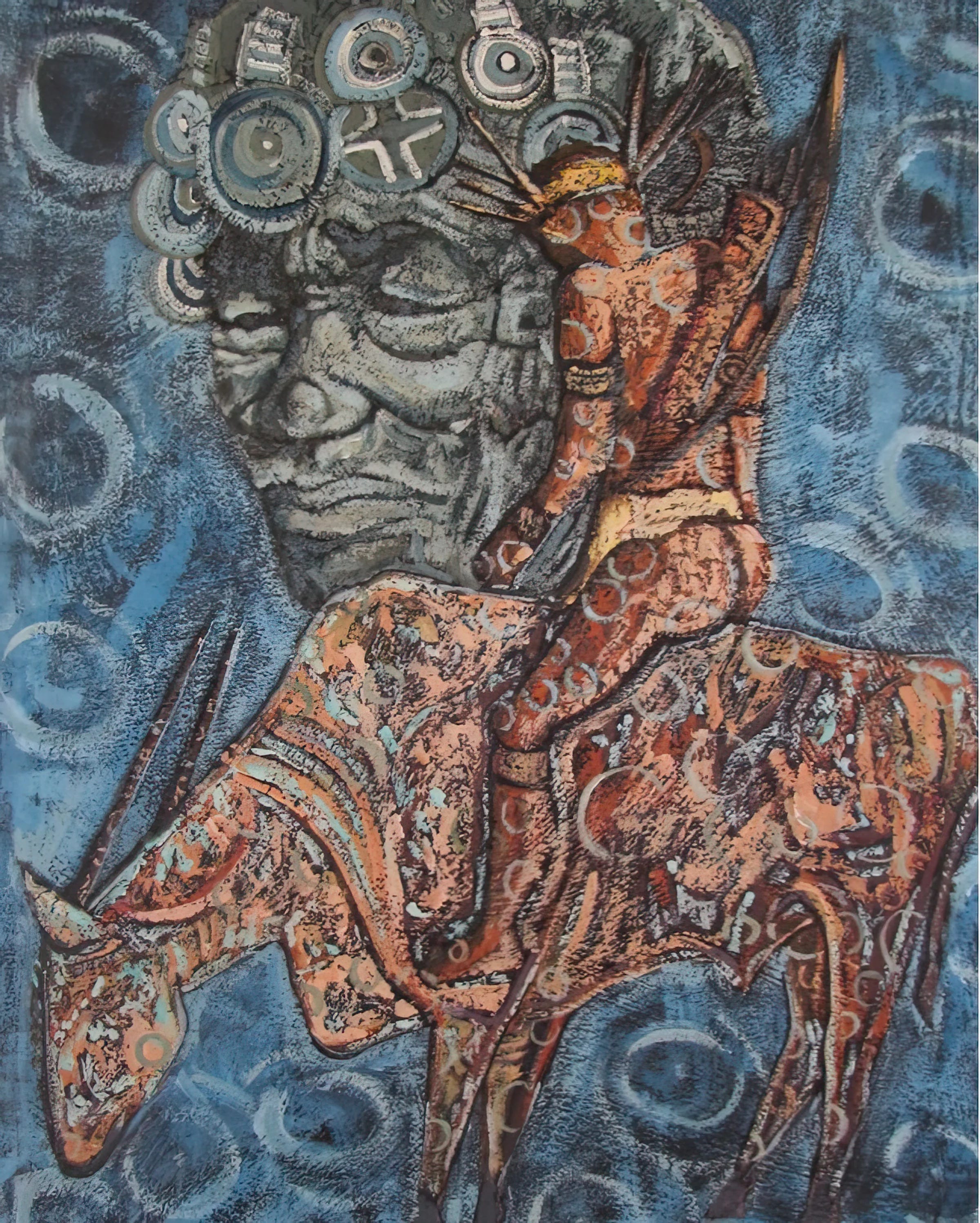
They were many. Not just rulers, but households, elders, children—lives lived inside systems of memory, labor, belief, and power that did not require a single name. “Rider” by Pierre Cloete (Khoi).
Before Europe learned to name Africa, Africa had already named itself—many times, in many tongues, across climates and centuries that did not speak to one another but nevertheless traded, argued, governed, remembered.
Along the Nile, political power learned early how to endure. Kingdoms organized labor around flood and surplus, measured time, taxed grain, and recorded authority in stone and script. South of Egypt, Nubia absorbed and reshaped these systems into its own imperial order. From Kerma to Meroë, Kushite rulers governed long enough to reverse the familiar direction of conquest, ruling Egypt itself for nearly a century as the Twenty-Fifth Dynasty. When Assyrian armies forced retreat, institutions outlasted occupation. The state did not vanish; it contracted, adapted, persisted.
In the Horn of Africa, Ethiopia followed no European timetable. Aksum rose beside the Red Sea as a commercial empire facing outward—trading with Rome, Arabia, and India, minting its own coinage, developing its own script. Christianity was adopted in the fourth century not as cultural mimicry but as imperial infrastructure, binding faith to governance while Roman authority fractured and reassembled itself elsewhere. When Islamic power later reshaped Red Sea trade, Aksum declined as a port empire, but its political-religious tradition migrated inland and survived. Ethiopian sovereignty did not pause for Europe’s Middle Ages.
Across West Africa, power moved along routes measured in discipline rather than romance. Gold, salt, and manuscripts crossed the Sahara in caravans governed by law, logistics, and scholarship. Mali ruled a wide network of cities and provinces through a confederation that balanced autonomy and control. Timbuktu was not a metaphor; it was an archive. When Mansa Musa passed through Cairo in the fourteenth century, the gold he distributed destabilized markets for years—not because of spectacle, but because Mali controlled the supply. When that control weakened, Songhai rose along the same arteries of trade, inheriting systems rather than inventing them anew.
Farther south, stone accumulated into order. Great Zimbabwe rose without mortar, granite laid course by course into walls that enclosed rulers, ritual, craftsmen, and merchants. Water was stored. Crops cultivated. Gold and ivory moved outward through African networks into the Indian Ocean world. The city waned not because it had never existed, but because power shifted northward to Mutapa. Later Europeans would insist the ruins could not be African, because the implication—that complexity predated contact—was intolerable.
Across the Sahara itself, the Garamantes built cities where none were supposed to survive. Underground tunnels carried fossil water from ancient aquifers, feeding fields and settlements deep in the desert. Rome absorbed the coastline and forgot the interior. When the water failed, the system collapsed. The desert reclaimed the infrastructure. History remembered only what empire had touched.
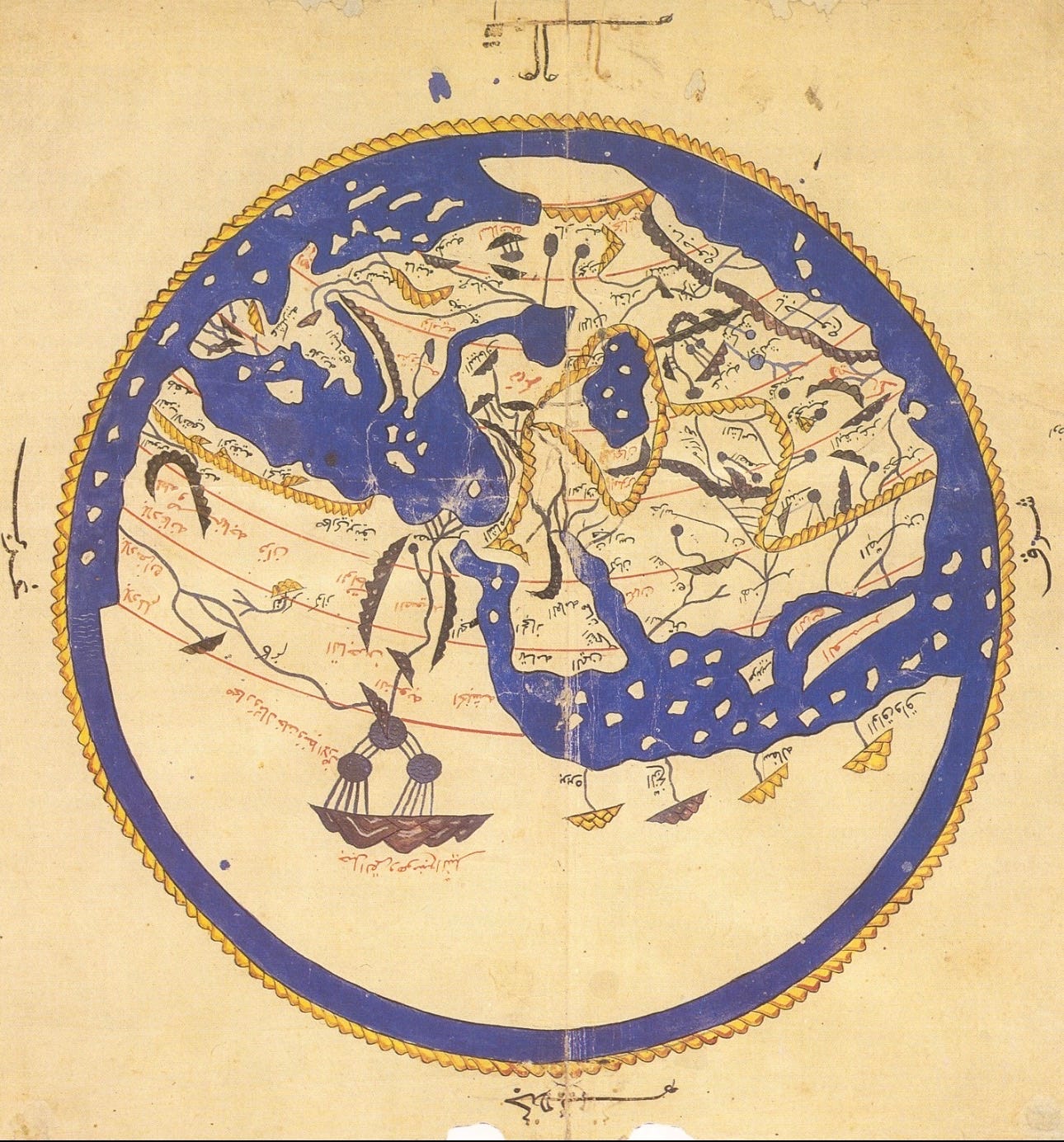
Image: This is Muhammad Sharif al- al-Idrīsī’s1154 map of the northern part of the continent —rivered, city-dense, with sophisticated trade routes---a connected space, not container. No modern nation-states. No colonial color blocks. Source: https://commons.wikimedia.org/wiki/File:Al-Idrisi%27s_world_map_Rotated_180_degrees.JPG

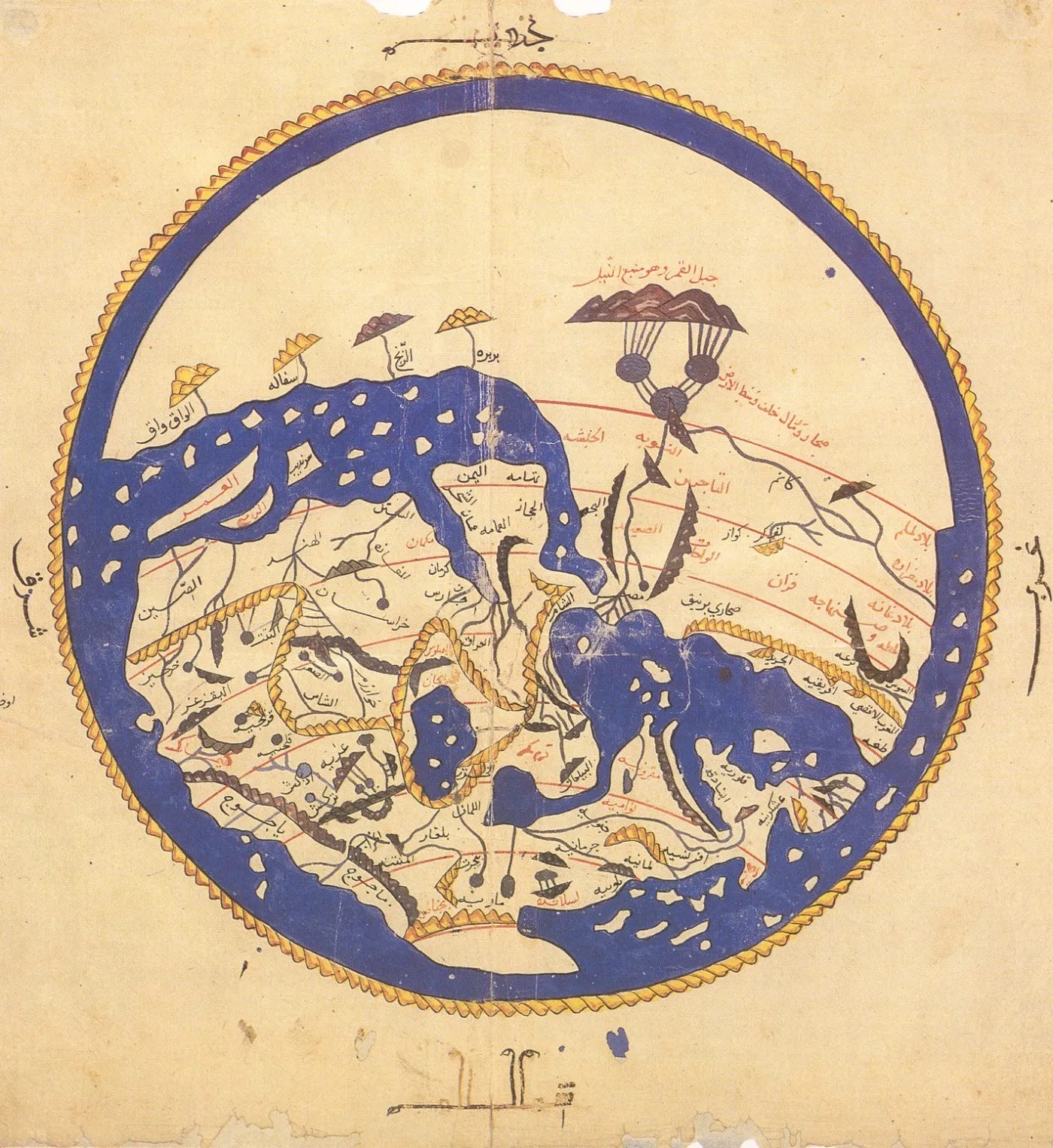
Reverse view of al-Idrīsī’s map from Alî ibn Hasan al-Hûfî al-Qâsimî’s 1456 copy. Source:
https://sacredfootsteps.com/2022/06/24/the-complex-story-behind-al-idrisis-iconic-world-map/
In the forests of Benin, memory was cast into metal. Courtly bronzes—made from imported manillas—recorded lineage, hierarchy, and power in a visual archive unmatched in contemporary Europe. They were not decorative objects; they were records of statecraft. When British forces destroyed the kingdom in 1897, the bronzes were dispersed across museums, admired for craftsmanship while stripped of meaning. And far to the south, the Zulu kingdom rose quickly and spectacularly in the early nineteenth century, centralizing authority through military innovation, reorganizing society under Shaka’s rule. It was a modern state confronting European expansion not as backdrop but as opponent.
These worlds did not move together. They did not share a clock, a cosmology, or a political grammar. They touched at times—through trade, war, migration—but they did not require unity to exist. They governed themselves as many places, many systems, many histories.
The singular came later.
It arrived not through discovery, but through administration. Maps were laid flat. Borders were drawn cleanly. Rivers crossed. Kingdoms split. Languages severed. What would later be called the Scramble for Africa was, in practice, paperwork—conference rooms, signatures, rulers pressed across paper. Administration posing as inevitability.
Knowledge adjusted itself accordingly. Africa became manageable once it could be spoken of as a single terrain, a single problem, a single destination. V. Y. Mudimbe would later describe this process in The Invention of Africa: Africa was not merely ruled; it was re-described. Anthropology replaced history. Classification replaced memory. The continent was rendered legible by being flattened.
Only then does comparison enter—and its asymmetry matters.
Russia, sprawling across continents, is handled delicately. The line is precise: Ural Mountains, Ural River, Caspian Sea, Caucasus. Three-quarters of the land lies east, but three-quarters of the people live west. Moscow and St. Petersburg face Europe. Siberia becomes space, not identity. Asia, in this telling, is distance—absorbed without dissolving Russia’s claim to European seriousness.
Asia itself never stays intact. East Asia. South Asia. Southeast Asia. China is not Japan. India is not Pakistan. Indonesia is not Mongolia. Even contested places—Hong Kong, Taiwan—are spoken of distinctly.
The Americas fracture easily. North America subdivides into nations, then states. South America becomes Brazil, Argentina, Peru. The Caribbean is Jamaica, Haiti, the Dominican Republic. The Pacific is Tonga, Samoa, Fiji. New Zealand is patiently explained—seated atop Zealandia, mostly submerged but still granted specificity. Australia alone bears the odd burden of being both country and continent, treated as curiosity rather than collapse.
Only Africa remains whole.
In speech. In headlines. In philanthropy. In pop culture. Fifty-four independent countries reduced to a single noun. Occasionally the spell breaks. Egypt is lifted out, rendered legible through Greece and Rome. South Africa is framed as exceptional—modern, post-apartheid, intelligible. The rest recedes into abstraction.
This abstraction has cultural scaffolding. Conrad’s river leads inward, not across borders but into a moral fog where Africa becomes metaphor. Blixen’s Kenya is rendered lovingly, but always as experience—landscape, loss, longing—never as a political world. Africa appears not as actor, but as setting.
As Said’s Orientalism showed, the West secures coherence by producing an undifferentiated elsewhere. Mills later named the governing logic in The Racial Contract: power determines not only who governs, but who defines reality—who receives plurality, who receives blur.
Africa receives blur.
To speak of Africa as a country is not a mistake corrected by a map. It is the residue of centuries of training—of learning which places deserve detail and which can be held at a distance. It is what remains after empires recede but their categories stay behind.
Long before the word collapsed into one meaning, Africa moved as many worlds. It still does.
The grammar simply hasn’t caught up.
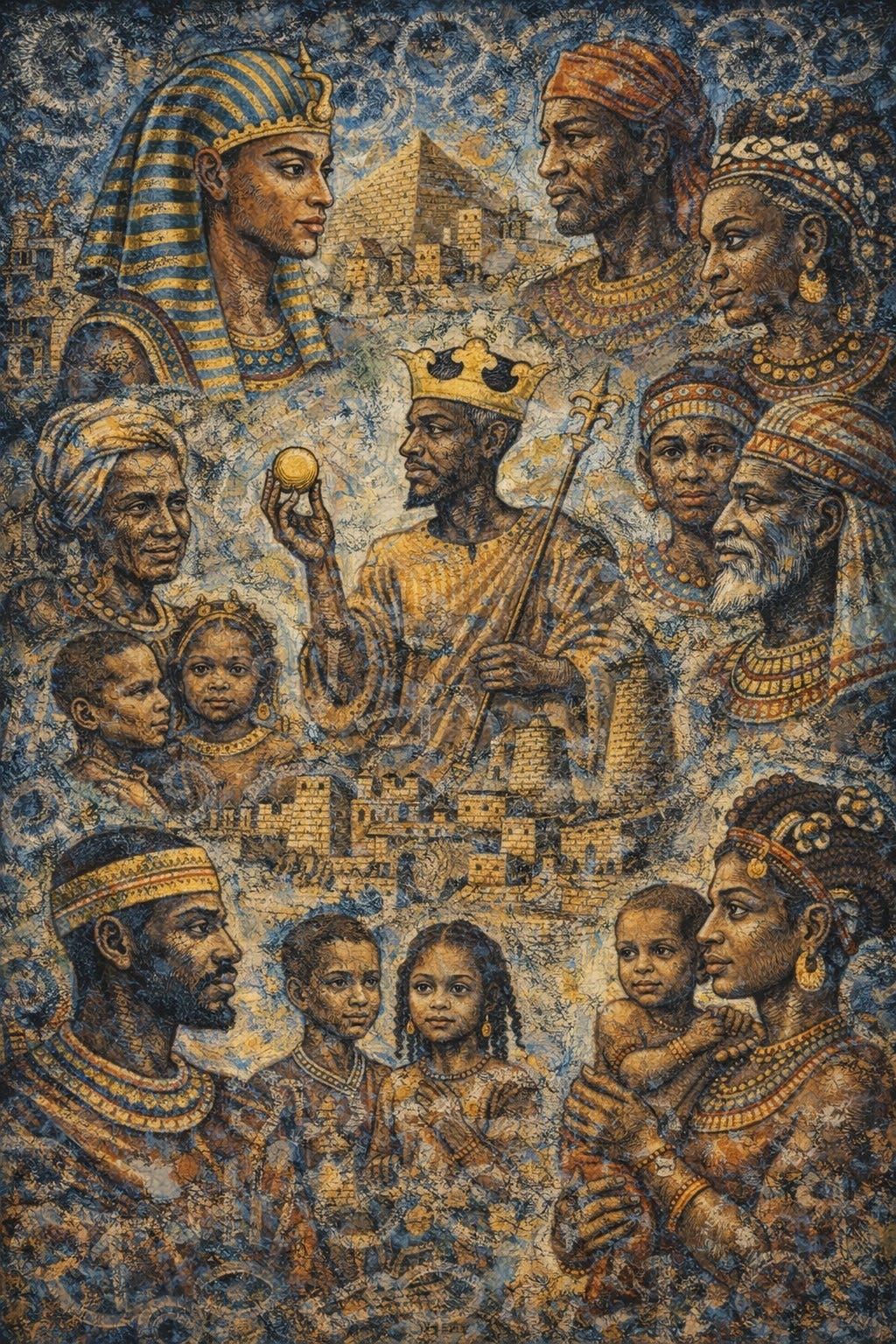
Image: Composite illustration inspired by precolonial African societies (Ancient Egypt, Kush, Aksum, Mali, Ghana, Great Zimbabwe), created for this essay, 2025.
Video: Bill Gates referring to Africa as a country. Source: Financial Times.
Intellectual Map
Anderson, Benedict. Imagined Communities: Reflections on the Origin and Spread of Nationalism. London: Verso, 1983.
Mudimbe, V. Y. The Invention of Africa: Gnosis, Philosophy, and the Order of Knowledge. Bloomington: Indiana University Press, 1988.
Pakenham, Thomas. The Scramble for Africa, 1876–1912. New York: Random House, 1991.
Manning, Patrick. Africa in World History. 3rd ed. New York: Routledge, 2014.
UNESCO. General History of Africa. 8 vols. Berkeley: University of California Press; Paris: UNESCO, 1981–1993.
Africa No Filter. Africa No Filter. Accessed December 24, 2025. https://africanofilter.org
Wainaina, Binyavanga. “How to Write About Africa.” Granta 92 (2005): 92–95.
Meredith, Martin. The Fortunes of Africa: A 5,000-Year History of Wealth, Greed, and Endeavor. New York: PublicAffairs, 2014.
Mills, Charles W. The Racial Contract. Ithaca, NY: Cornell University Press, 1997.
Said, Edward W. Orientalism. New York: Pantheon Books, 1978.
Dinesen, Isak [Karen Blixen]. Out of Africa. New York: Random House, 193
Conrad, Joseph. “Heart of Darkness.” Blackwood’s Edinburgh Magazine 165, no. 1007–1009 (February–April 1899).
Thank you for this.
I am reminded of Gandhi's reply when asked what he thought about western civilization.
"I think it would be a good idea."
Your frames and reframes are very helpful for sharing with others.