
Roll, Jordan, Roll
Let the waters rise. Let the crossing come. How Black people freed themselves.

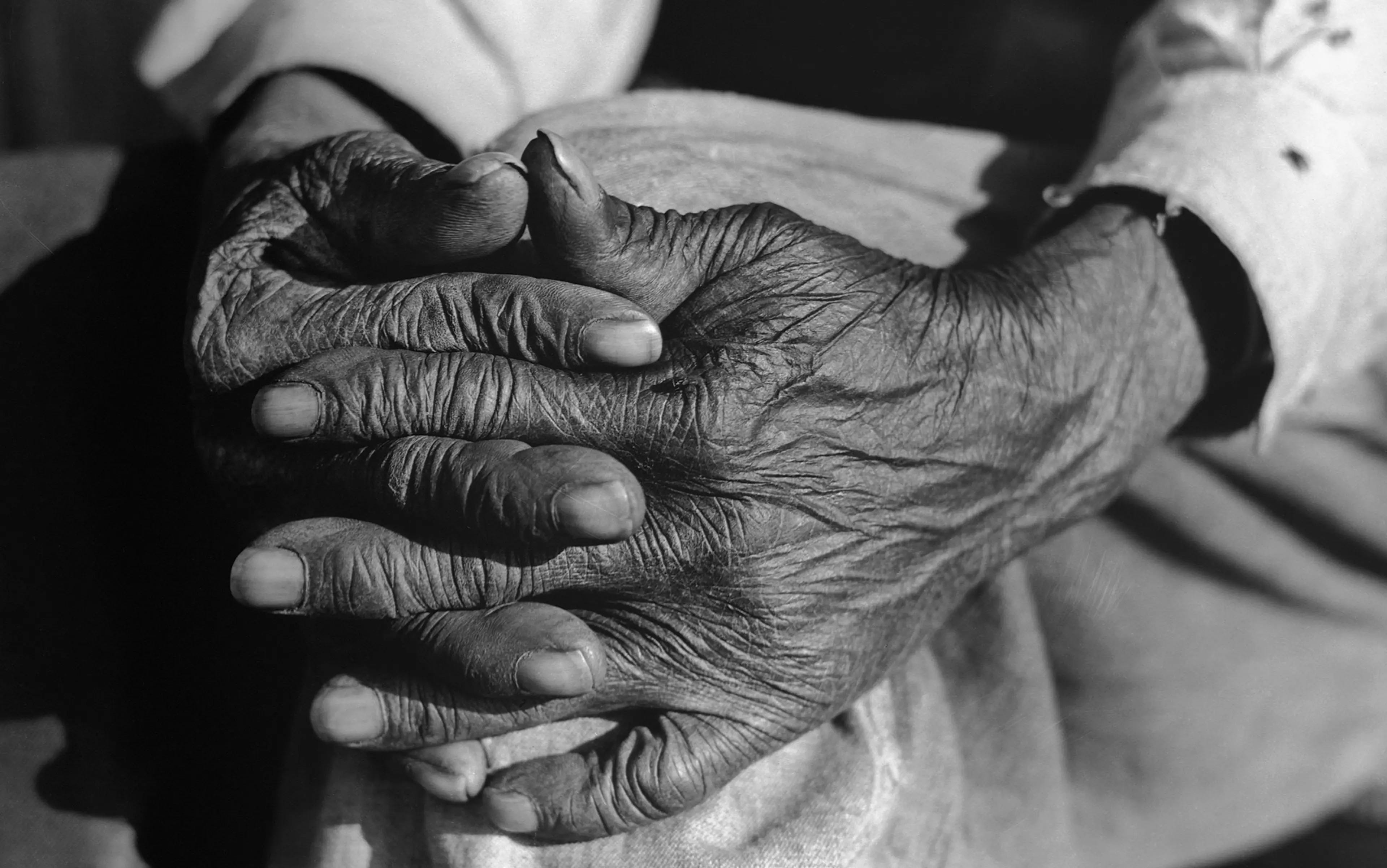
Image: “Hands and Feet,” Slavery, and the Making of America, PBS. Source: https://www.thirteen.org/wnet/slavery/experience/education/feature2.html
Before the horn, there was the woods.
The path to the Great House Farm ran through pine and sand, rutted pale by hooves and bare feet. On allowance-day, the selected men and women stepped onto it before first light, sacks over shoulders, tin pails knocking softly against their legs. The Great House waited at the end of that road—the place where pork was weighed, corn meal measured, cloth issued, punishments confirmed. The seat of calculation.
But on the path, before the ledgers and the scales, there was sound.
A single voice would rise first—thin, testing the air—then lengthen. Another would join, not to harmonize but to answer. The rhythm found their walking. Pine needles pressed underfoot in time with breath. They did not look at one another for cues. There was no sheet, no signal. As Frederick Douglass remembered, “They would compose and sing as they went along, consulting neither time nor tune. The thought that came up, came out—if not in the word, in the sound.”
The woods took it and gave it back.
“I am going away to the Great House Farm!
O, yea! O, yea! O!”
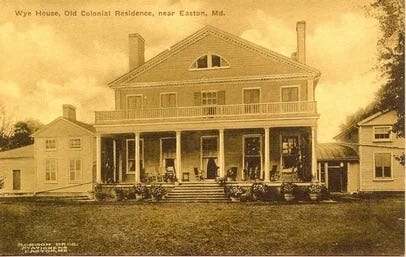
Image: Wye House, The Great House Farm, A Robson Bros. Stationers Easton, Md. postcard. Late 19th century/early 20th century. Talbot County Free Library. https://www.tcfl.org/mdroom/postcards/collection/pages/035.html
The chorus leapt bright, almost exultant, rising above the treeline. But beneath it ran something else—a drawn-out note, a bend in the voice that did not resolve. They would “sometimes sing the most pathetic sentiment in the most rapturous tone, and the most rapturous sentiment in the most pathetic tone.” The contradiction was not an accident. It was the point.
The plantation counted bodies. By 1820, more than a million and a half enslaved people stood entered in census columns, reduced to tallies beside acreage and livestock. In account books they appeared as “one male, age 22,” “one girl, age 9,” their value appraised in dollars. Tobacco and corn moved outward to market. Human beings moved inward to punishment or sale.
But on the road to the Great House Farm, no columns held.
The singing began as walking, but it was more than movement. It was release. The thought that could not be spoken in the field could be carried in tone. The anger that could not be named before an overseer could bend a note downward until it trembled. The hope that had no guarantee could leap upward in a refrain.
Frederick Douglass, who as a boy walked within that circle, would later search for language equal to what he had heard: “They would make the dense old woods, for miles around, reverberate with their wild songs, revealing at once the highest joy and the deepest sadness.” Joy and sadness did not cancel each other. They occupied the same breath.
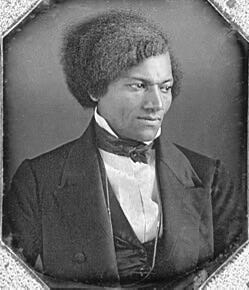
Image: Frederick Douglass photograph taken in the 1840s. https://frederickdouglassbirthplace.org/
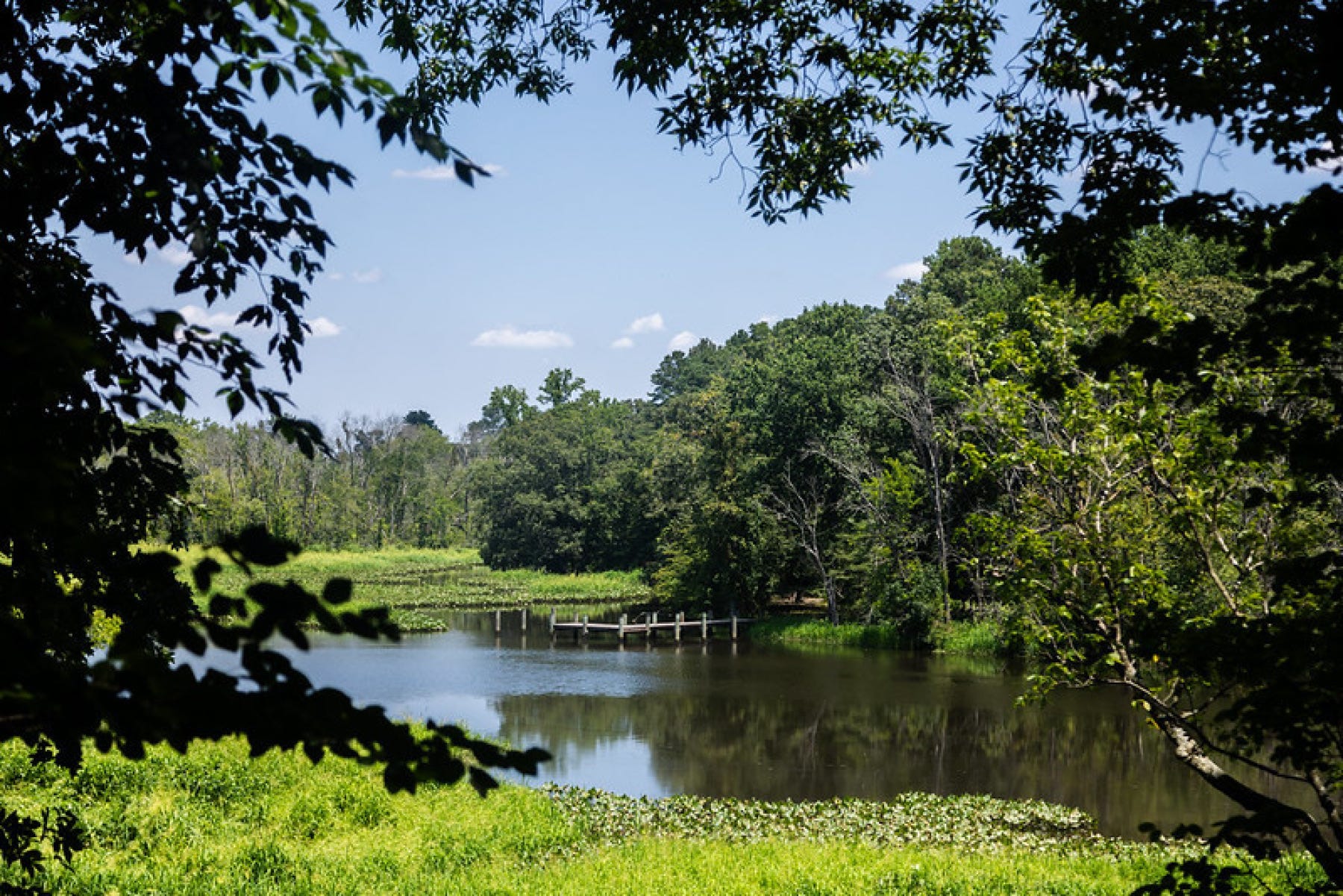
Image: Upstream of Tuckahoe Creek, near the birthplace of Frederick Douglass Park. (Photo by Marielle Scott/Chesapeake Bay Program). https://www.chesapeakebay.net/news/blog/near-the-birthplace-of-frederick-douglass-a-lush-wetland-park-awaits
In the fields, speech was dangerous. A complaint could be reported. A question could be punished. Mr. Severe, his name eponymous, stood at the quarter door with hickory stick and cowskin, ready to awaken by “the sense of feeling” those not stirred by the horn. The system left little room for argument.
Song moved differently. It carried no direct accusation. It named no overseer. It left no sentence to seize.
“They told a tale of woe,” Douglass wrote, though as a child he did not yet grasp it. “They were tones loud, long, and deep; they breathed the prayer and complaint of souls boiling over with the bitterest anguish.” The anguish did not disappear in the singing; it was shaped. It was given contour.
The melody did not sit neatly on the ear. A bright line broke into a moan. A low murmur surged suddenly into a cry. The sound was not polished; it was pressed from the body. “The songs of the slave represent the sorrows of his heart,” Douglass insisted, “and he is relieved by them, only as an aching heart is relieved by its tears.” The relief was not freedom. It was breath taken and released.
From the road, a passerby might have mistaken it. Douglass knew that error well. “I have often been utterly astonished…to find persons who could speak of the singing, among slaves, as evidence of their contentment and happiness. It is impossible to conceive of a greater mistake. Slaves sing most when they are most unhappy.” The brightness in the chorus was not proof of ease. It was defiance against suffocation.
The sound traveled ahead of them and lingered behind. It slipped through pine trunks and settled in the chest of the boy listening. “The hearing of those wild notes always depressed my spirit, and filled me with ineffable sadness,” he recalled. “I have frequently found myself in tears while hearing them.” He did not yet understand that he was hearing indictment. “Every tone was a testimony against slavery, and a prayer to God for deliverance from chains.”
On the plantation, power moved by measure—by pound, by bushel, by lash. Names bent into numbers. Tobacco weighed. Corn tallied. Flesh entered beside livestock and plow.
In the woods, power moved differently.
A heel struck sand. A palm met a thigh. Breath caught, then broke into syllable. One voice rose thin as smoke. Another answered. The trees held it, sent it back altered.
The singing did not shorten the row of tobacco. It did not lighten the sack of corn. It did not stay the whip. The horn would still sound. The gate would still swing.
But before the horn—there was this.
From the road, it might have sounded like laughter. A white passerby could have mistaken the rhythm for ease, the rise and fall for contentment.
Under the pines, a woman bent over her pail and let the note stretch longer than breath should allow. A man, shoulders welted, answered low, almost steady. The sound moved between them, crossing the space the overseer claimed but did not understand.
No ledger marked it.
In the quarters that night, someone would hum the same line again, softer now, rocking a child whose name had already been entered in another book. The melody thinned but did not disappear. It waited in the chest. It gathered in the throat.
Silence would have meant something else: the row unbroken, the body compliant, the breath unused.
So they sang.
Not to sweeten the work. Not to bless the lash. They sang the way a body gulps air when held too long under water. They sang until the woods answered back.
And when the horn finally split the morning, the last note hung there a moment—unmeasured, unpriced—before folding into the day’s arithmetic.
Example of field holler
Example of work song:

Image: Aerial view of Wye House on Maryland’s Eastern Shore, the plantation seat of Col. Edward Lloyd, who enslaved more than one thousand people. From this ordered landscape of fields, river access, and Georgian symmetry radiated a regime of labor that bound enslaved families—among them Frederick Douglass’ kin—to the rhythms of the Great House Farm.

Image: Wye House along the Wye River, home of the Lloyd family and workplace of Capt. Aaron Anthony, who enslaved Frederick Douglass and members of his family. The calm geometry of driveways and lawns belies the scale of human captivity that sustained the estate’s tobacco and grain empire within the wider Chesapeake slave economy.
Intellectual Map
Primary Sources (Nineteenth Century)
Bradford, Sarah H. Harriet, the Moses of Her People. New York: Lockwood & Son, 1886.
Douglass, Frederick. Narrative of the Life of Frederick Douglass, an American Slave. Written by Himself. Chapter 3. Boston: Published at the Anti-Slavery Office, 1845.
Douglass, Frederick. Narrative of the Life of Frederick Douglass, an American Slave, Written by Himself. Edited by Benjamin Quarles. Cambridge, MA: Belknap Press of Harvard University Press, 1960. Originally published 1845.
Library of Congress. “The Song of the Contrabands.” Accessed February 28, 2026. https://www.loc.gov/item/lomaxbib000058/.
Library of Congress. “The Song of the Contrabands.” Accessed February 28, 2026. https://www.loc.gov/resource/lhbcb.25385/?sp=31&st=single.
Library of Congress. “Image 2 of The Song of the Contrabands.” Accessed June 10, 2021. https://www.loc.gov/resource/ihas.200001991.0/?sp=2.
Spence, John. Annals of Rutherford County. Vol. 2. Rutherford County Historical Society, 1991.
Scholarly Secondary Sources (Peer-Reviewed Books & Articles)
Bercovitch, Sacvan, and Cyrus R. K. Patell, eds. Nineteenth-Century Poetry, 1800–1910. Vol. 4. Cambridge: Cambridge University Press, 1994.
Cohen, Michael. “Contraband Singing: Poems and Songs in Circulation During the Civil War.” American Literature 82, no. 2 (2010): 271–304.
Metcalfe, Ralph H. “The Western African Roots of Afro-American Music.” The Black Scholar 1, no. 8 (1970): 16–22. http://www.jstor.org/stable/41206250.
Scholarly Essays & Academic Digital Publications
Bridgewater State University. “Songs of Slavery and Freedom.” Undergraduate Review. Accessed February 28, 2026. https://vc.bridgew.edu/cgi/viewcontent.cgi?article=1516&context=undergrad_rev.
Commonplace. “Hearing Slavery.” Accessed February 28, 2026. https://commonplace.online/article/hearing-slavery/.
Cox, Donna M. “The Power of a Song in a Strange Land.” The Conversation, September 3, 2020. https://theconversation.com/the-power-of-a-song-in-a-strange-land-129969.
Public History & Government Sources
National Park Service (U.S. Department of the Interior). “The Superpower of Singing: Music and the Struggle Against Slavery.” Accessed February 28, 2026. https://www.nps.gov/articles/000/the-superpower-of-singing-music-and-the-struggle-against-slavery.htm.
National Park Service (U.S. Department of the Interior). “What Is the Underground Railroad?” Accessed February 28, 2026. https://www.nps.gov/subjects/undergroundrailroad/what-is-the-underground-railroad.htm.
Sutherland, Claudia. “Stono Rebellion (1739).” BlackPast.org, September 18, 2018. https://www.blackpast.org/african-american-history/stono-rebellion-1739/.
Thirteen/WNET. “Slavery and the Making of America: History.” Accessed February 28, 2026. https://www.thirteen.org/wnet/slavery/experience/education/history.html.
Journalistic & Popular Interpretive Sources
Barry, Kenyatta D. “Singing in Slavery: Songs of Survival, Songs of Freedom.” PBS: Mercy Street Revealed. Public Broadcasting Service. Accessed February 28, 2026. http://www.pbs.org/mercy-street/blogs/mercy-street-revealed/songs-of-survival-and-songs-of-freedom-during-slavery/.
Black Music Scholar. “Field Hollers and Work Songs.” Accessed February 28, 2026. https://blackmusicscholar.com/field-hollers-and-work-songs/.
Drumming for Peace. “African Drumming in Early America (Part 1).” January 1, 1970. http://drummingforpeace.blogspot.com/2009/02/african-drumming-in-early-colonial.html.
FolkWorks. “Songs of Slavery, Survival, and Freedom.” Accessed February 28, 2026. https://folkworks.org/article/songs-of-slavery-survival-freedom/.
Hausman, Sandy. “Fleeing to Dismal Swamp, Slaves and Outcasts Found Freedom.” NPR, December 28, 2014. https://www.npr.org/2014/12/28/373519521/fleeing-to-dismal-swamp-slaves-and-outcasts-found-freedom.
Milwaukee Independent. “Slave Songs and Spirituals Spoke the Black Experience in America Prior to 1863.” Accessed February 28, 2026. https://www.milwaukeeindependent.com/syndicated/slave-songs-spirituals-spoke-black-experience-america-prior-1863/.
PBS. “Songs of Survival and Songs of Freedom During Slavery.” Mercy Street Revealed. Accessed February 28, 2026. https://www.pbs.org/mercy-street/blogs/mercy-street-revealed/songs-of-survival-and-songs-of-freedom-during-slavery/.