
The Rorschach Republic
How three crises—Reconstruction, Watergate, and January 6th—revealed America’s fractured psyche and the peril of democracy shaped by perception rather than fact.

Stack Polemics
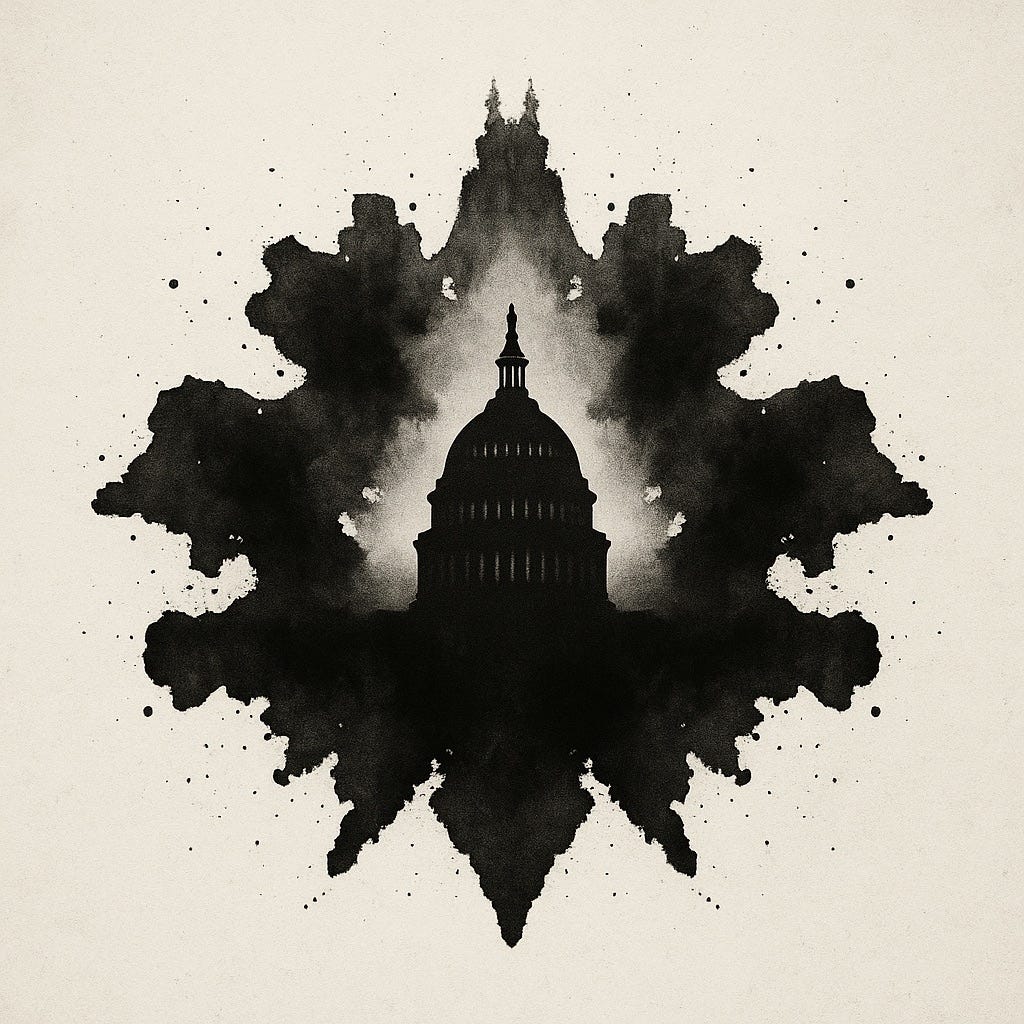
There are moments in American history when democracy itself has been put on trial—not just in courts, not only in Congress, but in the minds of the people. Those moments did not arrive with clarity. They arrived like inkblots, shapeless until citizens projected meaning onto them. Reconstruction. Watergate. January 6th. Each was a crisis; each was also a test. A Rorschach test.
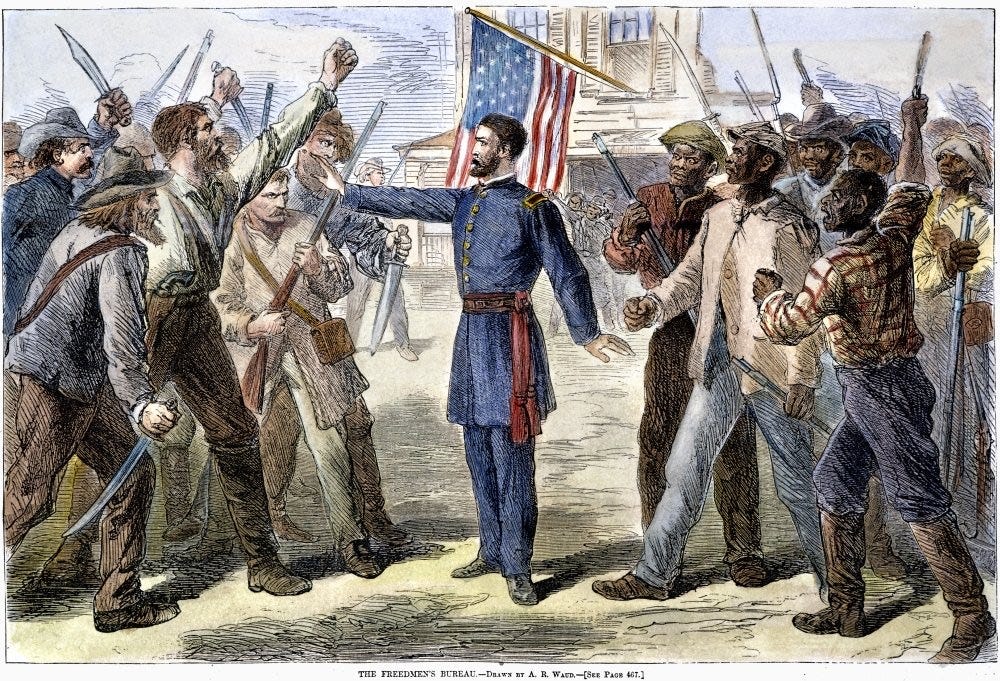
Image: Union soldier representing the Freedman's Bureau stands between armed groups of Euro-Americans and Afro-Americans, The Freedmen's Bureau / Drawn by A.R. Waud, 1868. Library of Congress. https://www.loc.gov/item/92514996
Reconstruction
The war had ended, the Union preserved, slavery abolished. But what came after was not a settled peace. It was an inkblot. To freedmen, Reconstruction represented the long-promised fulfillment of American democracy—citizenship, suffrage, schools, the possibility of land. To white southerners, it was occupation, humiliation, a government in which Black men held office and white supremacy stood challenged. The same federal troops that guaranteed ballots to freedmen were seen by former Confederates as tyrants trampling local self-rule.
The Freedmen’s Bureau could be a lifeline or a symbol of corruption, depending on what one chose to see. Even the Fourteenth and Fifteenth Amendments—plain in their text—were read by one side as democracy perfected, by another as democracy perverted. Reconstruction was a national inkblot, its meaning contested in every courthouse, every polling place, every southern legislature.
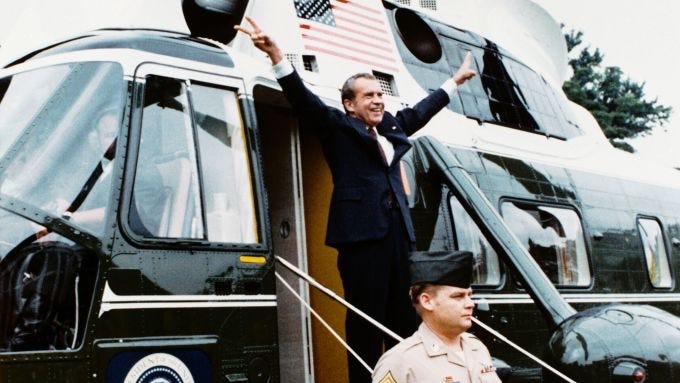
Image: Richard Nixon flashes his trademark V signs before boarding Marine One and leaving the White House grounds on August 9, 1974. The night before, he had announced that he would resign as president because of the Watergate scandal.Oliver F. Atkins/National Archives.
Watergate
A century later, another inkblot spread across the newsprint of the nation. The burglary at the Watergate complex began as a petty crime. It became, in time, the most serious constitutional crisis since the Civil War. Yet to millions, what they saw in it depended on what they were prepared to believe.
For some, Watergate revealed the strength of American democracy—the press exposing corruption, Congress investigating the president, the courts demanding compliance with subpoenas, and finally a resignation that affirmed no man was above the law. To others, it was proof that politics had become a blood sport, a witch hunt orchestrated by Nixon’s enemies, a test of loyalty rather than legality.
Even Nixon’s final act—the helicopter lifting off the White House lawn—was read in two ways: as disgrace, or as dignity in stepping aside to spare the nation further trauma. The inkblot offered no single meaning. It offered a choice.
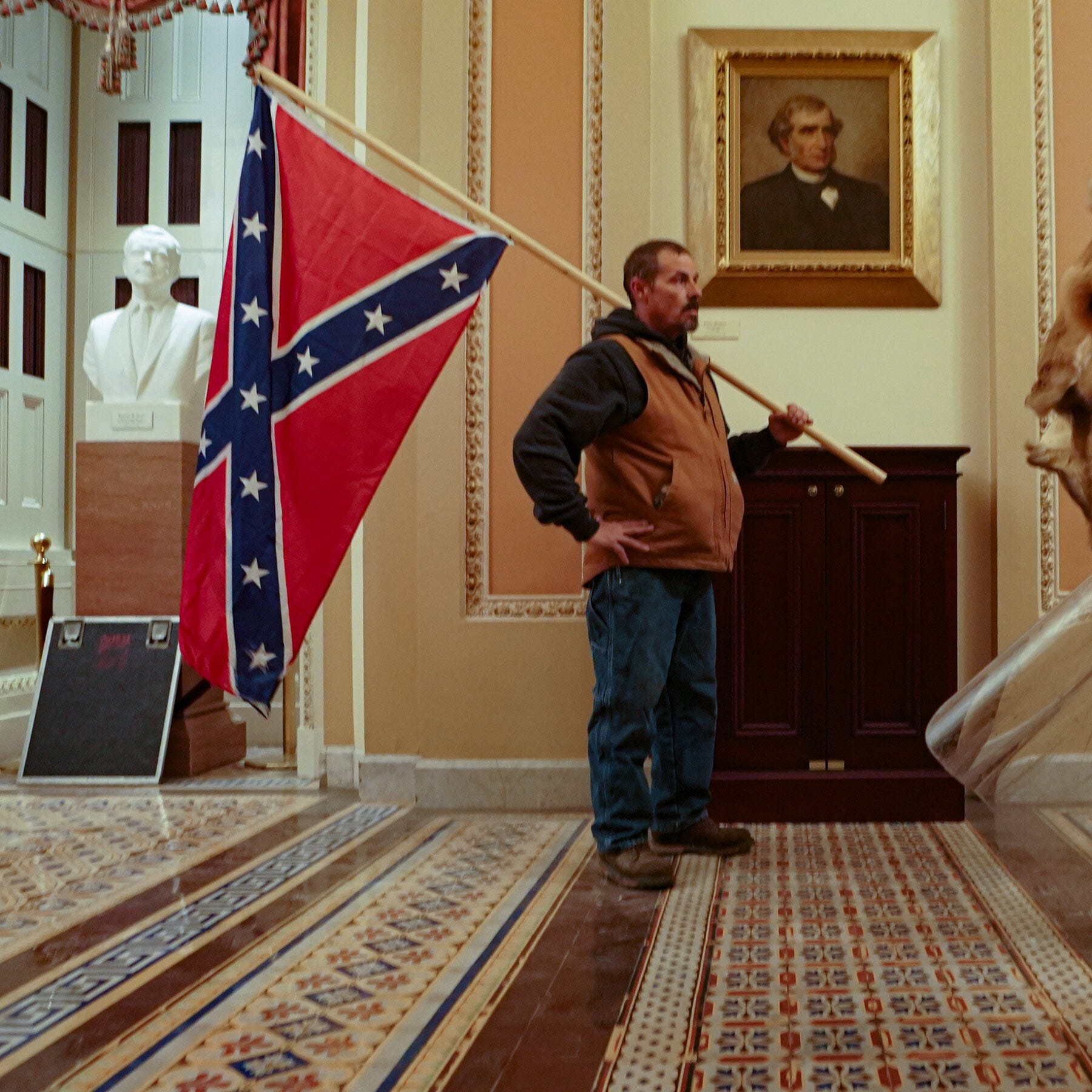
Image: The Confederate flag made it deeper into Washington on Jan. 6, 2021, than it did during the Civil War,” a professor said of the siege at the Capitol. Erin Schaff/The New York Times
January 6th
And then came the mob on January 6th, 2021. Images burned into the American mind: flags carried through broken windows, a noose erected outside the Capitol, lawmakers fleeing in fear. What did Americans see?
For many, it was an insurrection, the violent rejection of an election, the closest brush with authoritarianism since Reconstruction’s overthrow. But for others, it was protest, even patriotism, the people reclaiming a stolen victory. The same gallows could be read as symbol or threat. The same chants—“Stop the steal!”—as defense of democracy or its destruction.
The Rorschach test was not confined to the rioters. It extended to Congress itself. Some members returned to the chamber that night determined to certify the election, to prove democracy could not be shaken. Others voted still to overturn the results, seeing legitimacy not in ballots but in loyalty to a leader.
Image: Congressional inkblot.
The Pattern
Reconstruction. Watergate. January 6th. Three different crises, three different centuries, the same dynamic. Democracy presents an inkblot, and the people decide what it means. One nation looks at the same events and sees freedom, law, accountability. Another looks and sees tyranny, conspiracy, betrayal.
The danger is not only in the events themselves. It is in the widening gap between interpretations. A Rorschach test is meant to reveal the psyche of the patient. America’s psyche, revealed across these episodes, is fractured. A republic cannot function if it cannot agree even on what it is seeing.
The Present Inkblot
Today’s challenges—voter suppression laws, Supreme Court rulings, disinformation campaigns—are only the latest blots on the page. They will not tell Americans what they mean. Americans will tell themselves. The peril is that the country may no longer share enough common ground to see the same shapes at all.
That is the test. Not the inkblot. The nation.
Image: "Whose house?" The White House.
The Skeptic’s Counterpoint
There is a danger in the metaphor. A Rorschach test suggests subjectivity without hierarchy—that each interpretation, however strange, carries its own validity. But democracy is not an inkblot on a therapist’s page. It is a system of institutions, laws, and facts. And not all interpretations of those facts rest on equal ground.
During Reconstruction, white southerners claimed that “Negro rule” was synonymous with chaos. Yet the record shows something else: schools founded, laws codified, governments elected that, for the first time, included the formerly enslaved. To call both views equally valid is to flatten history itself.
During Watergate, Nixon loyalists saw only a partisan vendetta. But the White House tapes—his own words, preserved on magnetic reels—demonstrated obstruction and abuse of power beyond any reasonable doubt. To describe the scandal merely as a matter of interpretation would be to erase the evidence.
And in January 6th, the gulf is even wider. The claim that the 2020 election was “stolen” has been tested in more than sixty courts. It has been rejected by Republican-appointed judges, Trump’s own attorney general, and state officials from both parties. The evidence is not ambiguous; it is absent. To call the competing narratives simply different readings of the same inkblot risks giving misinformation the same weight as truth.
That is the skeptic’s warning: that the Rorschach metaphor, powerful as it may be, obscures the deliberate distortion that now shapes American politics. In a democracy, perception matters, but perception unmoored from fact becomes weaponized. A lie, repeated often enough, produces its own inkblot—one designed not to reveal the mind of the viewer, but to control it.
Useful Sources:
Reconstruction
Du Bois, W. E. B. Black Reconstruction in America, 1860–1880. New York: Harcourt, Brace and Company, 1935.
Foner, Eric. Reconstruction: America’s Unfinished Revolution, 1863–1877. New York: Harper & Row, 1988.
Hahn, Steven. A Nation under Our Feet: Black Political Struggles in the Rural South from Slavery to the Great Migration. Cambridge, MA: Harvard University Press, 2003.
Watergate
Kutler, Stanley I. The Wars of Watergate: The Last Crisis of Richard Nixon. New York: Alfred A. Knopf, 1990.
Woodward, Bob, and Carl Bernstein. All the President’s Men. New York: Simon & Schuster, 1974.
Dean, John W. Blind Ambition: The White House Years. New York: Simon & Schuster, 1976.
January 6th and Contemporary Crisis
House Select Committee to Investigate the January 6th Attack on the United States Capitol. "Final Report of the Select Committee to Investigate the January 6th Attack on the United States Capitol." Washington, DC: Government Printing Office, 2022.https://democrats-cha.house.gov/sites/evo-subsites/democrats-cha.house.gov/files/evo-media-document/2025_01_06_January_6_Report_CHA.pdf
Ben-Ghiat, Ruth. Strongmen: Mussolini to the Present. New York: W. W. Norton, 2021.
Snyder, Timothy. On Tyranny: Twenty Lessons from the Twentieth Century. New York: Crown, 2017.
Parker, Christopher S., and Matt A. Barreto. Change They Can’t Believe In: The Tea Party and Reactionary Politics in America. Princeton, NJ: Princeton University Press, 2013.
it would take til eternity to reply
But the problem I have with the overall presentation of the reconstruction era is that it always focused on the south and whites who didn't want to grant black freedom and never on the north that didn't want to grant worker freedom. 1877, the year reconstruction ended, is the year the American civil war actually began. Yeah, they subdued the rioters...but that civil war continued and hasn't as of yet ended.
or it did end, is ending now.
The problem is we can use force and maintain control, or we can create solutions that are designed to fail without continuous force...civil rights legislation and court decisions required Ike and LBJ to send in troops.
Power of any kind over others becomes a struggle to control that power. Absalom my son! is the only history power can ever achieve...a continuous struggle.
After Bacon's rebellion, with way too few masters to control the workers, deliberate laws were established to separate them from ever unifying again to chase the masters all the way back to England.
In Africa and much of the colonized world, the majorities were able to unite and send the colonizers back to their own lands.
But too many inkblots of colonization were spilled over what had been many groups, or ethnicities, or tribes, or whatever term you like, that now had to be a country and the eur. still controlled the majority of the resources even upon departing. Corruption was the bribe and struggle for the power over the resources the different ethnicities still did not have and were still struggling to obtain.
Now you're a historian, and you know all of this better than I, but reconstruction didn't end (in my opinion) because of klannish tendencies in the south to take back control, but because northern industrialists saw a solid aristocratic need to reinstall the southern aristocracy to prevent the bleeding of scalawag-black government and local control of the land, roads, schools, c. into the north.
After the war there was nothing but laborer attempts in the north to share some of the power while many of those southern govts were reducing authority over others and giving more resources to more people. What if the coalition between blacks and whites reached into the north and workers (still primarily european) reached into their own bailiwick and they no longer controlled their own workers?
Frederick Douglas said there was a difference between chattel slavery and working for wages, but not much. The difference, he said, was freedom, but he never achieved that freedom until he became independent of all masters.
The post-Bacon legislatures in Maryland and Virginia created in the American psyche that the tribes in this nation were defined not between the workers and the masters but between blacks and whites.
But the white workers have nevertheless have not found their lives particularly appealing, and the Charlie Kirk's, c. are the absurdity of this dual psychological insight imposed on whites that they are better than black people but knowing they are not being treated very well.
Until unity can be established by directing the workers into a unified class then the kings of the corporatist elite and the candidates they give money to, chaos remains in the minds of citizens...and chaos in the minds creates chaos in the society and prevents stepping out of our four centuries + of defining our tribes by skin color.
Gotta disagree with you on one point: Watergate - breakng into the HQ of the Democratic National Convention - could never be a "petty crime".