
Thomas Jefferson’s Other Declaration
America’s most radiant promise of equality was never innocent. Jefferson’s own writings reveal why.

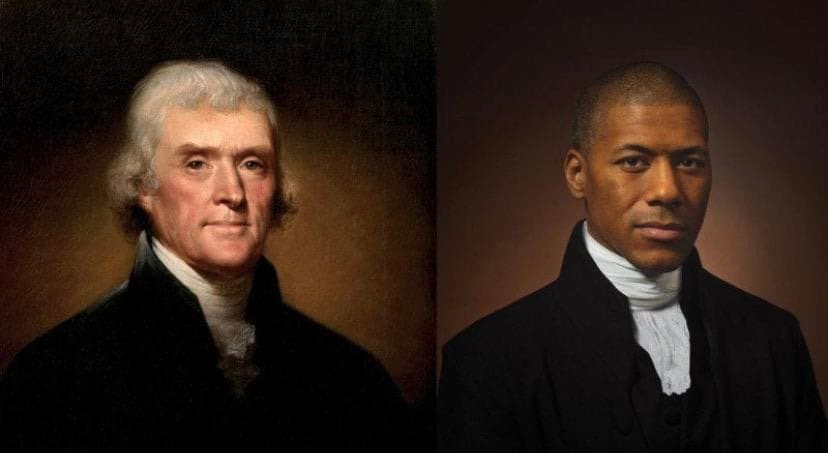
Image: Shannon LaNier, a TV news anchor, 6th great grandson of Thomas Jefferson and Sally Hemings. Artist for Jefferson: Rembrandt Peale; Artist for LaNier: Drew Gardner. Smithsonian Magazine. https://www.smithsonianmag.com/history/american-descendants-180975155/
Jefferson wrote the sentence as if it had come down from Sinai: “all men are created equal.”
No hesitation appears in the line. No qualification interrupts it. No footnote says who is missing.
The narrowing came elsewhere.
America learned to hear the sentence as if it belonged not to Jefferson, but to the ages. It would outlive him. It would leave his hand and move through other mouths, other centuries, other struggles. Abolitionists would seize it. Reformers would sharpen it. The excluded would force it to speak more broadly than Jefferson had imagined. But before the words became a national creed, Jefferson left another record on the page.
In Notes on the State of Virginia, Jefferson did not write about strangers. He wrote about people he enslaved, people whose labor sustained his world, and turned them into specimens. He studied their bodies, their hair, their skin, their memories, their reason, their imagination. Then he arranged them beneath white people and called the arrangement nature.
Black people, he wrote, were “inferior to the whites” in “body and mind.” In reason, they were “much inferior.” Their suffering did not move him toward equality. It became another occasion for judgment: “misery enough,” he wrote, “but no poetry.” Even love, in his account, did not lift Black people into the realm of imagination; it remained trapped in appetite. Line by line, comparison by comparison, Jefferson was building a gate around equality. He was explaining why the people he enslaved could be human enough to labor, suffer, reproduce, and obey, but not human enough to belong.
Here, the machinery of the contradiction appears. The Declaration opened with mankind; Notes on the State of Virginiaquietly closed the gate. The word men remains noble on the page because Jefferson had already decided who may stand inside it. Black people were close enough to labor, to be bought, sold, punished, inherited, and feared. But they were kept outside the circle where equality became citizenship, intellect, imagination, beauty, and rights.
He even imagined emancipation as danger. The problem was not merely slavery, in his telling, but what freedom might unleash: “deep rooted prejudices” among whites, Black memories of injury, and the “real distinctions which nature has made.” The enslaved had not forgotten. The enslavers had not repented. Jefferson saw the result not as justice delayed, but as social convulsion.
That is the American hinge: one hand writing universal equality, the other hand measuring human beings out of it. Jefferson did not need to deny the Declaration. He only had to define its subject narrowly enough. The promise could remain radiant because the excluded were made to stand in its shadow.
And he was not alone. Jefferson gave the contradiction unusually polished language, but the architecture was larger than Jefferson.
Madison turned bondage into constitutional arithmetic. In Federalist No. 54, enslaved people appeared not as men whose rights had been stolen, but as a problem of counting. The Constitution, he wrote, viewed them “in the mixed character of persons and of property.” Then he made the violence sound procedural: “This is in fact their true character.” Their condition was not treated as a crime against liberty, but as a legal category, “the character bestowed on them by the laws under which they live.” If the laws restored “the rights which have been taken away,” Madison admitted, Black people “could no longer be refused an equal share of representation with the other inhabitants.”
There it was, almost hidden in plain sight: equality was not unimaginable. It had been taken away.
Washington knew the law could threaten mastery. He could speak privately of abolition, but when Pennsylvania’s gradual abolition law endangered the status of enslaved people in the presidential household, caution gave way to concealment. If it became necessary to send them back to Virginia, he instructed Tobias Lear, he wanted it done “under pretext that may decieve both them and the Public.” The enslaved were not to know too much. The public was not to see too clearly. Even escape had to be managed through reputation. When one of the people he enslaved ran away, Washington wanted measures taken to recover him, but quietly: “I would not have my name appear in any advertisement, or other measure, leading to it.”
Patrick Henry gave the contradiction the sound of confession. “Would any one believe that I am master of slaves by my own purchase?” he asked. Then came the excuse, plain and damning: “I am drawn along by the general inconvenience of living without them.” He saw the wrong. He named the wrong. “I will not—I cannot justify it,” he admitted, “however culpable my conduct.”
Conscience spoke; convenience answered.
George Mason thundered against slavery with prophetic force: “Every master of slaves is born a petty tyrant. They bring the judgment of heaven on a Country.” Yet even that judgment did not break the bargain. At the Convention, slavery remained not merely a moral problem, but a political settlement to be managed. Charles Cotesworth Pinckney said the thing without ornament: “S. Carolina & Georgia cannot do without slaves.”
There it was, spoken in different registers: Madison’s law, Washington’s secrecy, Henry’s confession, Mason’s warning, Pinckney’s demand. Theory, caution, convenience, conscience, property, fear. The republic announced equality while protecting slavery; praised liberty while guarding property in human beings; spoke of mankind while building political belonging around whiteness. The scandal is not that the Founders failed to notice the contradiction. It is that many of them named it, managed it, profited from it, and then built a nation sturdy enough to protect it.
Intellectual Map
Primary Sources
Banneker, Benjamin. “Letter to Thomas Jefferson,” August 19, 1791.
Henry, Patrick. “Patrick Henry to Robert Pleasants, January 18, 1773.” https://constitutioncenter.org/education/constitution-101-curriculum/12-slavery-in-america-from-the-founding-to-americas-second-founding
Jefferson, Thomas. The Declaration of Independence. 1776.
https://www.archives.gov/milestone-documents/declaration-of-independence
Jefferson, Thomas. Notes on the State of Virginia. 1785. Especially Query XIV, “Laws.”
https://www.monticello.org/notes-on-the-state-of-virginia/query-xiv
Jefferson, Thomas. “Letter to Benjamin Banneker,” August 30, 1791.
https://teachingamericanhistory.org/document/letter-to-benjamin-banneker/
Jefferson, Thomas. “Letter to Henri Grégoire,” February 25, 1809.
https://teachingamericanhistory.org/document/letter-to-henri-gregoire/
Madison, James. Notes of Debates in the Federal Convention of 1787. August 22 and August 25, 1787.
https://avalon.law.yale.edu/18th_century/fed54.asp
Madison, James. “The Federalist No. 54.” February 12, 1788.
https://avalon.law.yale.edu/18th_century/fed54.asp
Mason, George. Remarks at the Federal Convention, August 22, 1787, in Madison’s Notes of Debates. https://csac.history.wisc.edu/wp-content/uploads/sites/281/2025/05/2.-mason-22-august-1787.pdf
Washington, George. “George Washington to Tobias Lear, April 12, 1791.”
Tobias Lear, Letters and Recollections of George Washington, (New York, 1906), 38; GW to William Pearce, 22 March 22, 1795, MTVL.
https://washingtonpapers.org/resources/articles/species/
Pinckney, Charles Cotesworth. Remarks at the Federal Convention, August 22, 1787, in Madison’s Notes of Debates.
https://csac.history.wisc.edu/wp-content/uploads/sites/281/2025/05/4.-pinckney-22-aug-1787.pdf
Secondary Sources
Davis, David Brion. The Problem of Slavery in the Age of Revolution, 1770–1823. Ithaca: Cornell University Press, 1975.
https://archive.org/details/problemofslavery0000unse_x8g4
Fields, Barbara Jeanne. “Slavery, Race and Ideology in the United States of America.” New Left Review 181 (May–June 1990): 95–118.
Finkelman, Paul. Slavery and the Founders: Race and Liberty in the Age of Jefferson. 3rd ed. Armonk, NY: M. E. Sharpe, 1996. https://archive.org/details/slaveryfoundersr0000fink
Gordon-Reed, Annette. Thomas Jefferson and Sally Hemings: An American Controversy. Charlottesville: University of Virginia Press, 1997.
Gordon-Reed, Annette. The Hemingses of Monticello: An American Family. New York: W. W. Norton, 2008.
https://archive.org/details/hemingsesofmonti0000gord
Gordon-Reed, Annette, ed. Jefferson on Race: A Reader. Princeton: Princeton University Press, 2026.
Gordon-Reed, Annette, and Peter S. Onuf. “Most Blessed of the Patriarchs”: Thomas Jefferson and the Empire of the Imagination. New York: Liveright, 2016.
Jordan, Winthrop D. White Over Black: American Attitudes Toward the Negro, 1550–1812. Chapel Hill: University of North Carolina Press, 1969.
https://archive.org/details/bwb_S0-BLL-054
Miller, John Chester. The Wolf by the Ears: Thomas Jefferson and Slavery. New York: Free Press, 1977.
https://archive.org/details/wolfbyearsthomas0000mill
Morgan, Edmund S. American Slavery, American Freedom: The Ordeal of Colonial Virginia. New York: W. W. Norton, 1975.
https://archive.org/details/americanslaverya0000unse
Sinha, Manisha. The Slave’s Cause: A History of Abolition. New Haven: Yale University Press, 2016.
https://archive.org/details/slavescausehisto0000sinh
Smith, Rogers M. Civic Ideals: Conflicting Visions of Citizenship in U.S. History. New Haven: Yale University Press, 1997.
https://archive.org/details/civicidealsconfl0000smit
Waldstreicher, David. Slavery’s Constitution: From Revolution to Ratification. New York: Hill and Wang, 2009.
https://archive.org/details/slaverysconstitu00wald
Van Cleve, George William. A Slaveholders’ Union: Slavery, Politics, and the Constitution in the Early American Republic. Chicago: University of Chicago Press, 2010.
You just brilliantly gave examples of what the Native American nations meant in a phrase attributed to them that said, “The white man speaks with forked tongue.”
Great article! Interesting how Washington was managing his public image. The examples in this article are clear evidence the framers had a consciousness of guilt. Also, no one could seem to extricate themselves from their financial conflicts of interest. I see a lot of motivated reasoning by the founding "fathers'. Everyone should be very cautious of sanctifying these men as saints.